

Google People Card - should Linkedin be concerned?
Google tests "People Cards" in India
Google has launched “People Cards” in India, that allow you to easily find people who want to offer their services, competences or qualifications. India is certainly treated as a region where Google is testing its new tool.
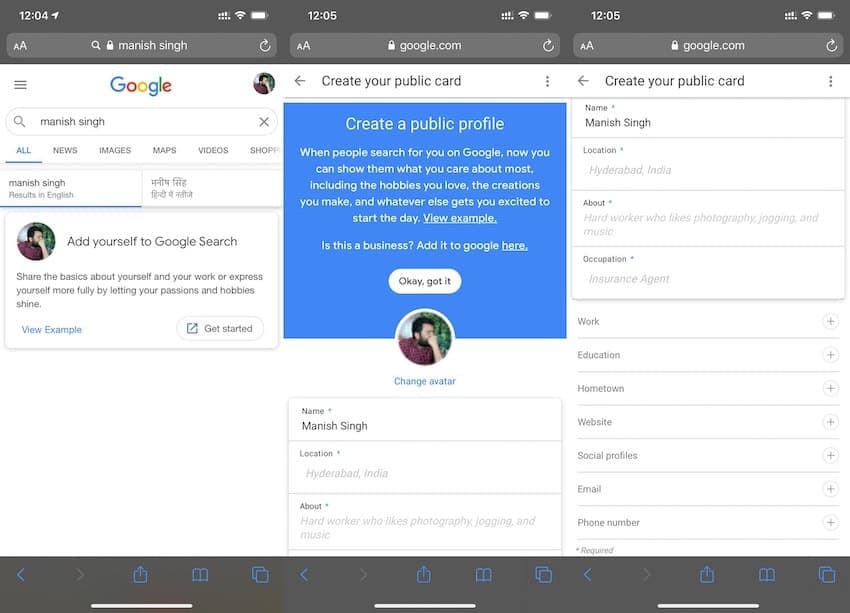
People Card allows you to add your own bio, photo, links to the website and social profiles and most importantly from the recruitment point of view – work experience, education and contact details.
As can be seen above, there is space on the right to provide information on work experience, education, and contact details that will probably be available to search for.
Google has tried in the past to create its own Google+ social network to compete with Facebook and Linkedin. The Google+ project eventually failed to sustain the pressure from Facebook and Linkedin and was shut down.
What is the advantage of People Card over Google+, Facebook, Linkedin, and other social networks? The advantage is essential – People Card is not a social platform. Anyone with a Google account (currently in India) can create their card and be found by all other users of the Google search engine. You do not need to register on the new platform. You do not need to log in and check if someone sent us a message. You share your own card in the world’s largest database – Google search engine and immediately gain exposure to the whole world. Even the combined forces of Linkedin and Facebook cannot offer exposure this big.
We will see how Google will manage this project. It is difficult to say at the moment whether People Cards will become a real threat to Linkedin in the area of recruitment.
In my opinion, the approach that frees the user from the closed platform, such as Linkedin, is revolutionary and has a chance to seriously threaten Linkedin’s position, for which I keep my fingers crossed.
As we reflect on the potential of Google’s People Cards, it’s intriguing to consider the possibilities for integration with modern Applicant Tracking Systems (ATS) like Element. Such a union could significantly streamline the recruitment process, enabling recruiters to gather and process candidate data more efficiently. The future of recruitment may well be shaped by these innovative digital intersections.
DISCOVER ELEMENT!
Maciej Michalewski
CEO @ Element. Recruitment Automation Software
Recent posts:

Anthropic believes it is creating a higher being. The dispute over Claude’s constitution
Anthropic teaches Claude that it may refuse even its own maker. I go through the All-In Podcast debate and the warning from Mustafa Suleyman of Microsoft AI.
Job offers in Poland, September 2026: growth without industry
In September 2026, employers in Poland posted 269,436 job ads, 2% more than a year earlier. Healthcare grows, and manual work is the only industry in decline.
The Automated Company, part 1: why we are building a company run by AI
Part 1 of The Automated Company series: why Element hands routine work to automation and where people still make the decisions.

Element races ahead: Slack, default filters and global template updates
We had barely refreshed Element’s look when a Slack integration, default filters, global message template updates and adding candidates straight from a CV arrived.
Element’s new look: another job done well by AI agents under human supervision
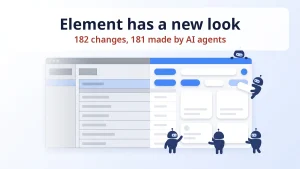
Element has a new look: Material 3 on top of a frontend rewritten from Angular 13 to 18, with 181 of 182 code changes made by AI agents under human supervision.
Job offers in Poland, August 2026: more ads, fewer jobs
Poland posted 257,046 new job ads in August 2026, up 4% year over year, even as employment in the enterprise sector fell. Data from the Grant Thornton report and my take.