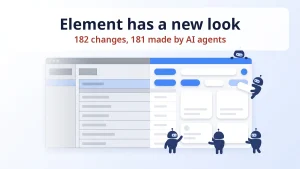
Element is developing faster than ever before

2026-06-10

The last few months have been one of the best periods in Element‘s history. I am not talking about sales momentum here, though, but about product development in the strict sense. The pace of rolling out improvements and new system features has never been this high. Naturally, all of this thanks to AI.

We do not have a new investor or other sources of funding, and we have not increased the number of hours our developers spend on the system. The only thing that has changed is that the quality of code generated by artificial intelligence has improved significantly.

My biggest problem: I never learned to code

Context matters, so let me remind you that I am not a programmer and I never had the chance to implement my own ideas, whose list never ended. This was essentially my biggest problem and, at the same time, Element’s biggest problem: plenty of ideas, but few resources to implement them. If only I could spend my own time programming the features I considered most valuable for our users. Unfortunately, I never learned to code.

Today I generate thousands of lines of code

That time has changed. Today I generate thousands of lines of code, if not daily, then easily weekly. Code that changes Element, delivering new features to users at a pace previously unattainable at our company. I generate the code with artificial intelligence, of course. I tell it what should change, what should appear in Element, and the AI turns my wishes into programming code that implements those changes in the system.

This code is not perfect, however. Like a human, AI still makes mistakes. While I build apps for my own use without worry, the code that real clients of our recruitment system will use must meet strict quality requirements, especially when it comes to the system’s security and stability. Let me remind you that Element is a recruitment system used by both global corporations and small startups, but it is not an irreplaceable system. The competition is strong, so if we did not take care of quality, clients would quickly move to other systems. The additional pressure on code quality and security comes from the fact that, as a recruitment system, we process hundreds of thousands, perhaps even millions of pieces of personal data.

How we ensure the quality of AI-generated code

How do you ensure the quality of code created by AI? Exactly the same way you ensure the quality of code created by a human. The basic tools are tests and code review. At Element we have a comprehensive automated testing architecture, we test the code manually, and a human always reviews code created by another human and by AI. What is more, asking AI to review its own code works great.

My vibe coding therefore looks like this:

  1. my own idea or an idea reported by users,
  2. thinking through whether it is worth it and how to implement the change,
  3. a conversation with AI about the idea and the way to implement it,
  4. AI creates a work plan,
  5. AI starts the implementation (coding),
  6. AI runs a code review of its own code,
  7. pushing the code into the comprehensive automated test pipeline,
  8. running the system locally and clicking through the changes,
  9. handing the code over for code review by one of our senior developers,
  10. pushing the code to the „staging” server, where we verify the changes once more,
  11. pushing the changes to the production server, that is, delivering the changes to clients.

Of course, after every review or test the code can return (and from time to time does return) to earlier stages.

From sales to generating code at the company

Let me add that the quality of code generation, supported by dozens of good practices remembered by my AI agents (mainly Claude Code), is already so high that the number of errors found by our senior developers is small. My guess is that they spend 5% of the time on reviewing my code that would have been needed to write that code by hand. This level of code generation quality meant that I went from being the person responsible for sales (finding and contacting clients) to the main code generator in the company.

Every day, from morning to night, I give instructions to agents that create new changes in Element. This code always has to be checked, so we shifted part of the developers’ hours from producing code to reviewing it. The bottleneck of product development is still the budget for developer hours, but right now, within the same budget, we can deliver many times more than a year ago.

AI is not just Element's code

Producing code for Element is not all I do thanks to AI. I am building a brand new idea in the recruitment industry, completely independent of the recruitment system. Something I had been thinking about for years, and only now can I start building it, thanks to AI. On top of that, I have created and keep creating many automations that simplify my everyday life and let me spend more time building and less on repetitive, non-educational, and usually boring tasks.

Today AI does things for me such as:

  1. searching emails,
  2. prioritizing tasks based on emails and calendars,
  3. finding and warming up leads,
  4. building apps that handle specific business processes, for example I built my own CRM, so I can stop paying for Pipedrive,
  5. carrying out all sorts of tasks such as filling in forms (signing Zosia up for a summer day camp, completing an official government form, filling in a form needed to prepare an offer for a client, creating the offer),
  6. SEO for the Element website,
  7. building hobby projects.

Generally, all office work is automated, except perhaps for writing texts like this one, although for less personal content I use AI as much as possible. I am surrounded by agents and I give instructions to agents. I have a whole team of them and I feel great about it. I build from morning to night, and I admit it is addictive for people who like to build. I cannot stop. What will the practical effect of this addiction be? Well, it is that Element already is, or soon will be, the recruitment system that delivers the most for the least. No system on the Polish market has costs as low as ours and, from what I can see, none delivers as many new features as Element.

Examples of features shipped in Element

Examples of features shipped in Element in the way described above:

  1. LinkedIn integration,
  2. NoFluffJobs integration,
  3. a public API,
  4. new windows/views in the system and a refresh of existing ones,
  5. automated bug fixing in the code,
  6. new ways of filtering projects and candidates.

Read more about ATS here.

DISCOVER ELEMENT!

Fast, agile and user-friendly ATS created by recruiters for recruiters
Picture of Maciej Michalewski

Maciej Michalewski

CEO @ Element. Recruitment Automation Software

Facebook
Twitter
LinkedIn

Recent posts: