

Candidate references vs GDPR: a LinkedIn poll

2022-08-22

A month ago I ran a LinkedIn poll about what recruiters would do if they received a reference about a candidate that was obtained in a way that violates GDPR rules. I created the poll while gathering material for an article about candidate verification tools and their legality under GDPR.

Below is the poll question, the results, and my commentary.

The poll: candidate references vs GDPR

Imagine the following situation.

You’re running a recruitment process for a management position. The person hired will manage a team of several dozen employees. A promising candidate has passed the final stage, but doesn’t yet know your decision about extending an offer.

Yesterday you ran into a friend who works at another company. This is someone whose judgment you trust — you regularly discuss difficult professional and personal decisions with them. It turned out, purely by coincidence, that your candidate used to work at your friend’s company. Your friend told you about seriously troubling behavior from this candidate — behavior that demotivated the team and created divisions. This included being rude to team members, mocking other people’s mistakes, and turning colleagues against each other. Your friend strongly advised you not to hire this person.

During the recruitment process, the candidate showed no signs of such behavior. In interviews, he spoke about excellent team management skills and great results. He seemed credible.

The law says recruitment decisions must be based on information provided by the candidate. If the candidate hasn’t given consent for you to contact their previous employer, you have no right to do so and cannot use information obtained that way in your hiring decision.

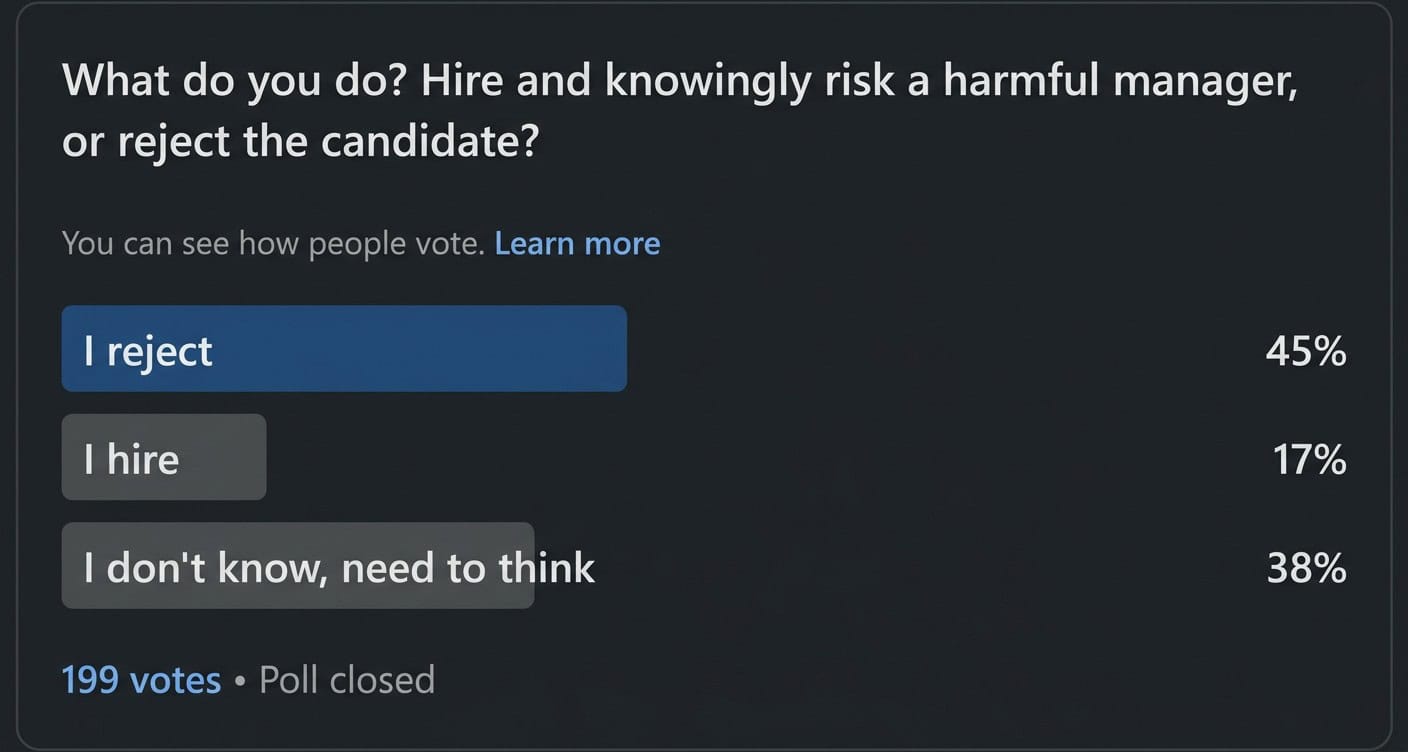
What do you do?

Hire the candidate, knowingly exposing the company and team to a harmful manager? Or reject the candidate?

A. I reject

B. I hire

C. I don’t know, I need to think about it.

This scenario came up during a webinar I hosted on June 23 about the legal aspects of verifying candidates’ employment history. A data protection officer who participated as an expert confirmed that you cannot make recruitment decisions based on information obtained from previous employers without the candidate’s consent.

According to LinkedIn’s report, the poll was seen primarily by (job title and number of people):

  1. Recruitment Specialist — 191
  2. Human Resources Business Partner — 186
  3. Human Resources Manager — 163
  4. Chief Executive Officer — 148
  5. Recruiter — 136
  6. Human Resources Specialist — 129
  7. Owner — 113
  8. Talent Acquisition Specialist — 90

199 people responded.

Poll results:

I reject: 45%

I hire: 17%

I don’t know, I need to think about it: 38%

The poll sparked a discussion with dozens of comments. We got into the details of various scenarios. I also clarified questions from several commenters. If you’re interested, here’s the link to the LinkedIn poll:

Commentary on the poll results

Most respondents chose an answer that contradicts the standard interpretation of GDPR. The regulation says you can only obtain a reference about a candidate from their previous employer with the candidate’s consent.

Experts also argue that even a reference obtained with the candidate’s consent shouldn’t be the basis for making a hiring decision (more on that in an upcoming article).

Why would most people act against GDPR? My take is simple — the regulations don’t match the reality of recruitment processes.

Shortly after I published the poll, the owner of a recruitment agency called me and shared a real-world example.

Managers and executives in the same industry often stay in touch with each other. These companies know whether a candidate moving from one company to another is a good hire. Information about candidates travels between companies. A manager currently at Company X may have previously worked with the candidate at Company Y and already has an opinion about them.

Under GDPR, you can’t collect references about candidates from other employers without the candidate’s consent. The cases above break that rule. But most people — as the poll confirms — won’t ignore negative information about a candidate, even if it was obtained without their consent. The agency owner told me that in such cases, the candidate is given a different, made-up reason for rejection — something like “you’re not a fit for our organizational culture.”

That kind of fake recruitment feedback is bad for everyone. The candidate gets lied to and doesn’t receive information that could actually help them grow. The employer is stuck justifying a decision with a fiction.

In my view, this isn’t the employers’ fault. It’s the fault of regulations that don’t match reality.

Read more about ATS and Element here.

DISCOVER ELEMENT!

Fast, agile and user-friendly ATS created by recruiters for recruiters
Picture of Maciej Michalewski

Maciej Michalewski

CEO @ Element. Recruitment Automation Software

Facebook
Twitter
LinkedIn

Recent posts: