

Google People Card - should Linkedin be concerned?
Google tests "People Cards" in India
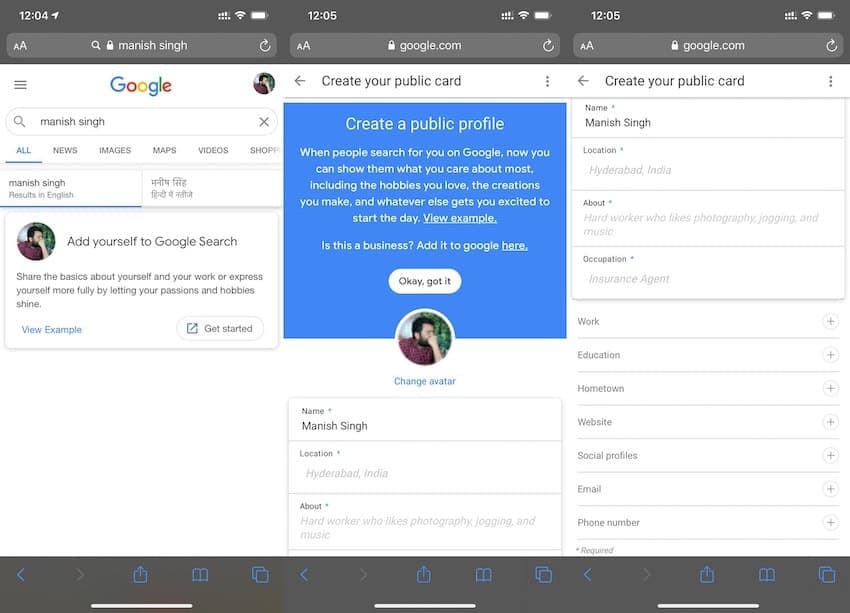
Google has launched “People Cards” in India, that allow you to easily find people who want to offer their services, competences or qualifications. India is certainly treated as a region where Google is testing its new tool.
People Card allows you to add your own bio, photo, links to the website and social profiles and most importantly from the recruitment point of view – work experience, education and contact details.
As can be seen above, there is space on the right to provide information on work experience, education, and contact details that will probably be available to search for.
Google has tried in the past to create its own Google+ social network to compete with Facebook and Linkedin. The Google+ project eventually failed to sustain the pressure from Facebook and Linkedin and was shut down.
What is the advantage of People Card over Google+, Facebook, Linkedin, and other social networks? The advantage is essential – People Card is not a social platform. Anyone with a Google account (currently in India) can create their card and be found by all other users of the Google search engine. You do not need to register on the new platform. You do not need to log in and check if someone sent us a message. You share your own card in the world’s largest database – Google search engine and immediately gain exposure to the whole world. Even the combined forces of Linkedin and Facebook cannot offer exposure this big.
We will see how Google will manage this project. It is difficult to say at the moment whether People Cards will become a real threat to Linkedin in the area of recruitment.
In my opinion, the approach that frees the user from the closed platform, such as Linkedin, is revolutionary and has a chance to seriously threaten Linkedin’s position, for which I keep my fingers crossed.
As we reflect on the potential of Google’s People Cards, it’s intriguing to consider the possibilities for integration with modern Applicant Tracking Systems (ATS) like Element. Such a union could significantly streamline the recruitment process, enabling recruiters to gather and process candidate data more efficiently. The future of recruitment may well be shaped by these innovative digital intersections.
DISCOVER ELEMENT!
Maciej Michalewski
CEO @ Element. Recruitment Automation Software
Recent posts:

The Great Reorg: companies are rebuilding around AI
Foundation Capital interviewed 25 companies and found that AI is not just speeding up work — it is forcing organizations to rebuild from the ground up around four human roles.

Gallup 2026: the workplace is cracking and managers lose drive faster than the rest
Gallup State of the Global Workplace 2026: engagement fell to 20%, managers lose drive faster than their teams, and the AI paradox is clear: personal productivity rises, organizational does not.

A Polish-founded robot that drives screws faster than humans
A Polish-founded robot that drives screws faster than humans When people think about automation, they usually picture chatbots, image generators, and coding assistants. Meanwhile, AI

People prefer AI poetry over Shakespeare
A study published in Scientific Reports (Nature) produced results that should interest anyone who thinks human creativity is easy to tell apart from machine output.

Three tools that measure AI’s impact on the job market
The debate about AI’s impact on the job market has been going on for years, but it only recently moved past the “experts predict” stage.

Poland’s job market: 238,000 offers and the specter of jobless recovery
In February 2026, Polish employers posted 238,000 job offers – 7% fewer than last year. Analysis of the Grant Thornton report and Element CEO commentary.