



Big Tech and politics: what the Capitol events mean for social networks
I am a technology person — the most obvious proof being Element. But the recent events in the US and their collision with technology, specifically social networks, are so wild that I had to write about them. Fair warning: this article has nothing to do with our recruitment system, recruitment, or HR. None of it.
Here we go.
Big Tech means the biggest US tech companies: Amazon, Apple, Google, Facebook, and Microsoft. In political conversations, Twitter gets lumped in too, mostly because of its outsized role in spreading information and its special place in political campaigns ever since Donald Trump made it his megaphone.
The Trump presidency was one controversy after another. And now we are watching the Big Tech part of the story blow up:
- Twitter — Trump’s account blocked, all posts deleted.
- Twitter — The official @POTUS account (President of the United States) — Trump’s latest posts are being removed, though the account itself stays up.
- Facebook — Trump’s account banned.
- Instagram — Trump’s account banned.
So what are American conservatives doing? They are migrating en masse to Parler, a messenger that promises more freedom around published content and no censorship of the kind they got used to on Twitter, Facebook, and YouTube.
The migration is so massive that Parler simply cannot handle the traffic. The app has been glitching and crashing for days.
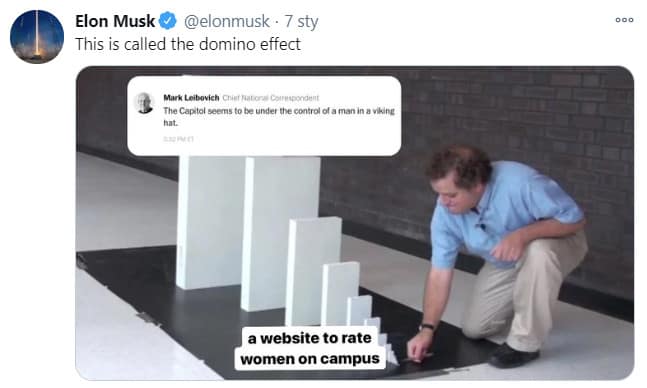
Meanwhile, Elon Musk — who has been going after Facebook ever since the Cambridge Analytica scandal (he deleted his own profile, Tesla’s, and SpaceX’s from the platform) — first called out the link between Facebook and the current political turmoil:
Then he pointed his 41 million Twitter followers at Signal as an alternative to Facebook’s messenger:
And what does Big Tech do in response?
Google and Apple pull Parler from their app stores, citing violent content. Amazon terminates its hosting agreement for the app. The notice period? 24 hours. Ruthless.
The polarization that social media feeds on (this mechanism was brilliantly laid out in the Netflix documentary The Social Dilemma) has cranked political conflict up to levels I have never seen before. And it has triggered a real exodus of users from the dominant platforms to alternatives like Parler, Minds.com, Signal, and Telegram.
What is happening right now is a clear signal that there is real demand for alternative platforms. This could trigger something that seemed almost impossible just a few years ago — the dominance of Twitter, Facebook, and Google actually slowing down, and eventually, cracking.
One more thing. I came across this observation while researching the topic:
I agree with the general point: politicians are dangerously dependent on Twitter and Facebook. But I have two issues with this take.
First, I disagree that people will not go where there is freedom of speech. They already are. Right now, conservatives are actively searching for new platforms, and the explosion in Parler and Signal downloads is direct proof.
Second, I do not think nationalizing Twitter or Facebook is realistic. What I do think is realistic? Legal restrictions on censorship. That feels much closer to actually happening.
To wrap up — I cannot stop watching this unfold. But I am worried, too. There are voices in the US calling for companies and individuals to be denied services based on their political or social views. I would really not want Google — whose services are the infrastructure behind our recruitment system — to come to us one day with an ultimatum to drop a client because that client’s business conflicts with some political stance. In Poland, this sounds absurd. But in the US, “cancel culture” is already very real.
DISCOVER ELEMENT!
Maciej Michalewski
CEO @ Element. Recruitment Automation Software
Recent posts:

HR services market in Poland 2025 – key findings from the PFHR report
Polskie Forum HR has published its annual report on the condition of the HR services market in Poland. Element is a technology partner of PFHR,

I Don’t See a Future for MS Office
Three phases of transition from clicking buttons to AI commands. Why Microsoft Office in its current form is destined to disappear.

Postings up 11%, Dorsey cuts 40%. What’s going on with dev jobs?
Postings up 11%, Dorsey cuts 40%. What’s going on with dev jobs? The data that surprised me I’ve been writing about work automation for years.

AI intensifies work instead of reducing it – consequences for HR
AI intensifies work instead of reducing it – consequences for HR The promise I personally believe in is tempting — artificial intelligence will take over

AI is not causing mass layoffs – what the report really says
It’s worth confronting opposing views and data that challenge our intuitions. That’s exactly the case with the “The Fire to Hire Cycle” report, which I
Automation: How Capitalism Is Leading Us to Socialism
Paradoxically, leaders of modern capitalism like Elon Musk are paving the way toward a socialist reality — through relentless automation that eliminates the need for human labor.