

Gallup 2026: the workplace is cracking and managers lose drive faster than the rest

2026-04-08

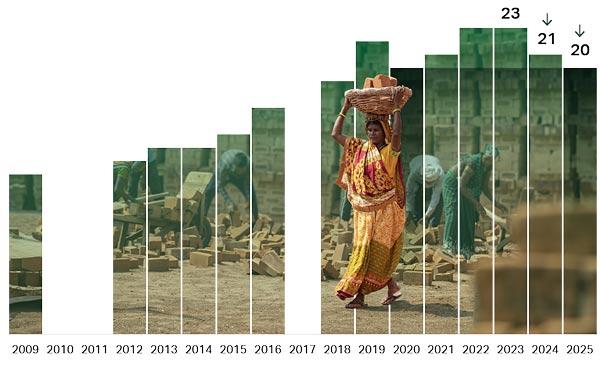
Global employee engagement dropped to 20% in 2025, the lowest level since 2020. It is the second consecutive year of decline, and Gallup estimates the cost at roughly $10 trillion in lost productivity, or 9% of global GDP. The new “State of the Global Workplace 2026” report confirms what I have been seeing for months in my work with companies adopting AI: the engagement crisis no longer hits only frontline workers. It hits managers hardest, the very people carrying the weight of the transformation.

The report draws on the largest ongoing study of the employee experience in the world. In 2025 Gallup collected 263,810 responses across more than 140 countries, including 141,444 from employed adults. The sample is large enough that the findings cannot be brushed off as noise, and most organizations will read them as uncomfortable, because many still believe technology alone will improve outcomes.

The shrinking perk of being a manager

The biggest shift in the report sits on the manager side. Since the 2022 peak their engagement has fallen by 9 percentage points, and between 2024 and 2025 alone it dropped from 27% to 22%. Individual contributors also declined, but less and with a small rebound in the past year. Gallup calls this “the shrinking perk of being a manager”, because historically managers enjoyed a clear engagement premium and now they are as burned out as the teams they lead.

The largest regional drop happened in South Asia, mainly India, where manager engagement fell by 8 points. Gallup links this directly to the IT sector hiring slowdown and to cuts at mid and senior levels, partly driven by AI adoption. Fewer managers means larger teams, and a separate Gallup U.S. study found that manager engagement decreases as span of control grows, although strong management training and talent can offset the effect.

The benchmark comes from organizations Gallup labels “best practice”. In 2025, 79% of managers in those companies were engaged at work, almost four times the global average. The difference does not come from industry or region. It comes from the fact that these firms treat employee engagement as part of long-term business strategy rather than a soft HR add-on.

Job market optimism depends on where you work

Global perception of the job market improved by 1 point to 52% of workers who say it is a good time to find a job. A deep asymmetry hides under that stable average. The entire increase came from fully on-site workers without remote capability, who gained 2 points. Over the same period, fully remote workers lost 5 points and remote-capable on-site workers lost 14 points.

Gallup ties the drop in optimism among remote-capable workers to two trends: employer pullback from remote roles and the automation of knowledge work. The U.S. and Canada region illustrates this best, with job market optimism falling from 70% in 2019 to 47% in 2025, a drop of 23 points. U.S. business media called 2025 the “no hire, no fire” era, and later revisions to official jobs data confirmed that the U.S. economy added 181,000 jobs last year compared with 1.5 million the year before.

Wellbeing rises, but leaders have worse days

After five years of improvement, employee wellbeing peaked in 2022 and then started to decline. In 2025 the thriving index rose by 1 point from 33% to 34%, with Latin America and Europe leading the rebound at 2 points each. Daily negative emotions, namely stress, anger and sadness, remain clearly above pre-pandemic levels, which Gallup interprets as either a lasting psychological effect or a tougher new normal.

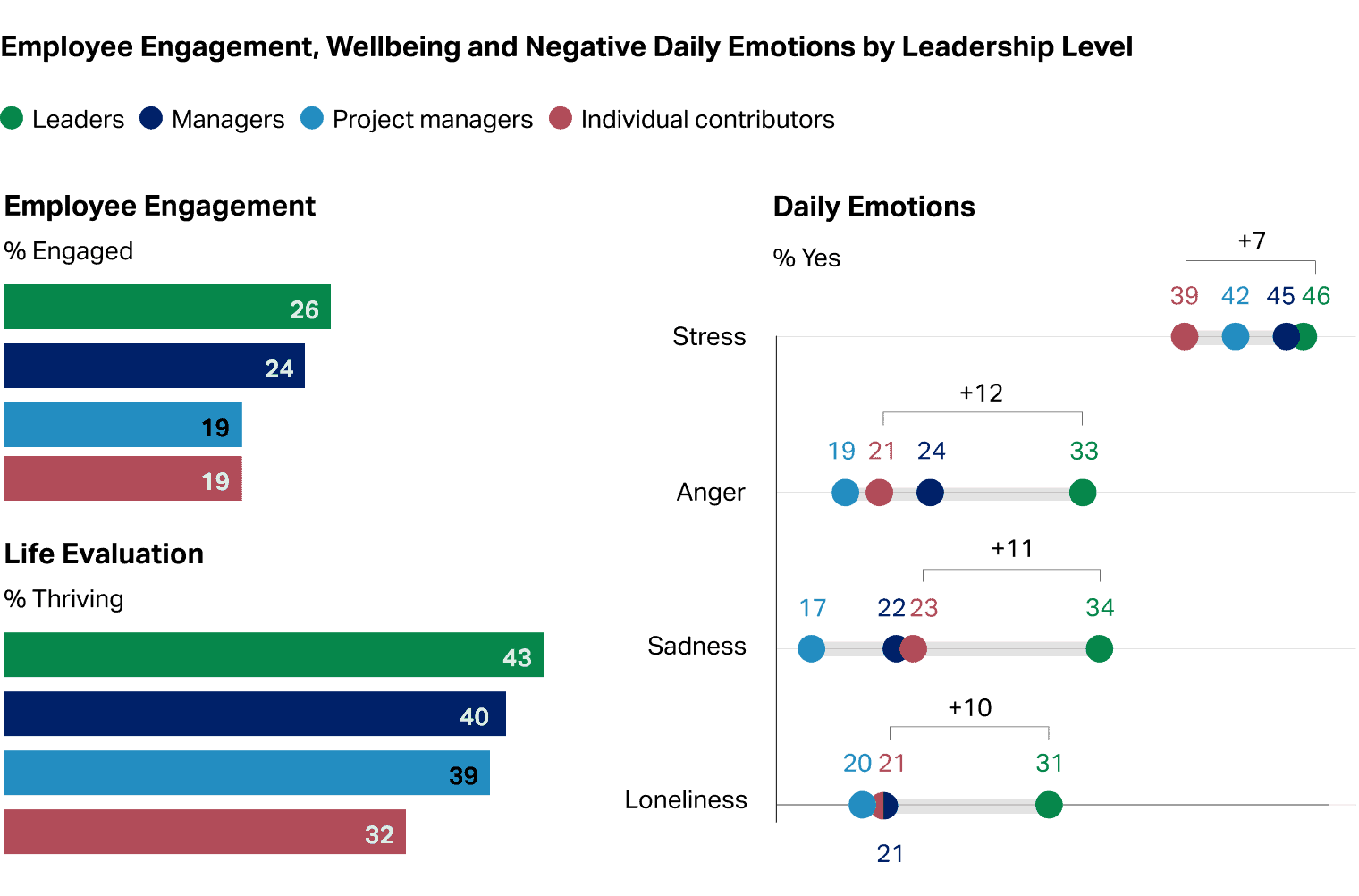
The most interesting observation in this section is the leader paradox. Leaders show higher engagement (26%) and higher thriving (43%) than individual contributors, but they also report stress 7 points more often, anger 12 points more often, sadness 11 points more, and loneliness 10 points more on the previous day. Leadership offers more agency and status, but it comes with social distance and the responsibility for painful decisions that affect many people.

The AI paradox: personal productivity rises, organizational does not

The AI section reveals a gap I see firsthand at clients. In U.S. organizations that have adopted AI, 65% of employees say AI had a positive effect on their personal productivity. Only 7% rate the effect as negative. At the same time, just 12% strongly agree that AI has changed how their organization gets work done.

The same gap appears on the leader side. The NBER study Gallup cites covered executives in the U.S., U.K., Germany and Australia. As many as 89% of leaders report no impact of AI on company productivity over the last three years, even though they expect a 1.4% gain over the next three. Personal gains are real, but they do not aggregate to the organizational level. This is the classic symptom of a company that handed people a new tool without rebuilding processes around it.

Gallup points to two factors that correlate most strongly with frequent AI use inside an organization: AI integration with existing systems, and active manager support for team adoption. Employees who strongly agree that AI is well integrated with their work systems use it frequently 86% of the time, compared with 52% in the group without integration. Where the manager actively supports AI use, frequent use is reported by 79% of the team, compared with 46% without that support.

The manager effect is even clearer when employees rate the value of AI. Employees in AI-investing organizations whose manager actively supports the team’s AI use are 8.7 times more likely to strongly agree that AI has changed how their organization works, and 7.4 times more likely to agree that AI gives them more opportunities to do what they do best. Despite these numbers, fewer than one third of U.S. employees in AI-adopting organizations say their manager actively supports team use of the technology. In Germany the figure is only 21%.

Fear of AI rises and large employers cut headcount

In Q1 2026, 18% of U.S. employees said it was “very” or “somewhat” likely that their job would be eliminated within five years due to automation or AI. In organizations that have already adopted AI, the figure rises to 23%. In finance and insurance it reaches 32%, and in tech 31%. In Germany 19% of employees in AI-using firms fear losing their job over the same horizon.

The size of the effect depends on employer scale. Among employees in AI-adopting organizations who work for the largest firms (10,000+ employees), 33% say their employer is reducing headcount and 30% say it is expanding. In smaller organizations the proportions reverse: in firms with 5,000-10,000 employees, 38% report headcount expansion and only 23% report cuts. AI-adopting organizations are more likely to change team size in either direction than non-adopters, which means the technology amplifies structural decisions rather than determining them. It is worth remembering that HBR research has shown that AI often intensifies work instead of reducing it, so headcount cuts after AI rollout do not always reflect real time savings for the teams.

What this means for people building teams

The takeaway from the Gallup report matches what I have been seeing at Element clients for months. AI adoption without active manager support leads to personal gains that never aggregate to organizational outcomes. A manager who cannot show the team how to weave AI into daily work becomes the bottleneck of the transformation, even when they use the tools themselves. Investing in manager training on concrete AI workflows pays back more than yet another corporate license.

The second issue is manager wellbeing. Gallup shows that engaged managers report all negative emotions less often than individual contributors and are 14 points more likely to be thriving than the average leader. Investing in manager engagement is an investment in their psychological resilience, not only in team results. This matters when designing recruitment and screening, where ATS systems like Element take repetitive tasks off managers’ plates and give them back time for the human work that needs their presence.

The third observation is the hardest to act on but the most important long term. “Best practice” firms reach 79% manager engagement, almost four times the global average. The difference does not come from technology. It comes from treating engagement as a business metric rather than an HR topic. AI adoption looks the same. Companies that roll out AI as just another productivity tool get personal gains. Companies that roll out AI as part of strategy and rebuild their processes and manager roles around it get a real lift in organizational performance.

This article is based on the State of the Global Workplace 2026 report published by Gallup. All charts come from the same source.

DISCOVER ELEMENT!

Fast, agile and user-friendly ATS created by recruiters for recruiters
Picture of Maciej Michalewski

Maciej Michalewski

CEO @ Element. Recruitment Automation Software

Facebook
Twitter
LinkedIn

Recent posts: