

The autonomous company: how Replit does it with AI agents, and how to do it yourself
An autonomous company does not mean a company without people. The way I see it, the point of the term is that people still choose the goal while performing fewer and fewer of the steps themselves. Replit, a Y Combinator startup valued at around 9 billion dollars, described this model in an essay titled “The Self-Driving Company” by Amjad Masad and Scott Kennedy, which Masad also announced in a post on X. Below I break the pattern down, then show how to run it yourself, even if your business is a one-person or few-person shop.
What an autonomous company actually means
The definition in the article is precise and worth quoting directly: “People still choose the destination. They decide which problems matter, make difficult tradeoffs, exercise taste, and take responsibility for the outcome. But increasingly, they do not perform every step required to get there.” I am not describing an empty office where machines replaced the staff. What I would say matters is a different thing: people stay the authors of the decisions, while a growing fleet of agents takes over the routine execution.
Masad and Kennedy frame this as a promotion rather than a cutback. Their people, in their own words, “don’t feel like they’ve been automated. They feel like they’ve been promoted”, because autonomy “turns doers into directors”. There is also a line that captures the difference between buying off-the-shelf SaaS and building your own tools: “Suddenly, the tools are built for us.”
Reading that paragraph again, I remembered why “turns doers into directors” resonates with me so strongly. It is because I keep telling people at my workshops that this is exactly what the next phase of work automation will look like: the routine clicking moves to AI, and we become the leads of AI-agent teams, the directors themselves.
How a single agent works
The whole construction rests on one repeatable pattern for how an agent operates. The agent takes a goal from a human, gathers the context it needs on its own, does the work, checks its own result, and when human judgment is required, escalates the matter to a person. That loop matters more than any specific technology, because it decides whether the automation is safe. Verification and escalation act as the safety catches: the agent does not pretend to know everything, it hands the decision back wherever the stakes are too high.
What Replit's numbers show
Replit shared hard data from the first half of 2026, January through June. In that window the team shipped 5.8 times more lines of code, and after adjusting for hiring it came to 2.9 times more code per engineer. The engineering team itself doubled, while output per person tripled. Agentic assessment of pull requests saved about 30 percent of human review time and that share keeps growing, while revert rates, incident counts and review latency stayed flat or dropped despite the tripled code output.
The effect shows up outside engineering too. In customer support the hardest tickets close about 60 percent faster, and the internal tools the company built, for things like alert triage and penetration testing, beat the commercial equivalents at roughly one tenth of the cost. I am inclined to think that last number is the most interesting one: an agent fitted to one specific process tends to be cheaper and more effective than a universal off-the-shelf product, and that is exactly the point behind the line about tools being built for us. That last point resonates with me too, this idea of internal tools built in-house. It resonates because I built a complete CRM of my own, fitted far better to how I actually work, and it replaced the Pipedrive I had relied on for years.
What agents do across the company
At Replit the agents do not sit only in engineering. They investigate production incidents and run root-cause analysis, review pull requests and assess the risk of changes, answer internal questions and generate semantic queries against the data warehouse. On the business side they analyze data, triage support tickets according to playbooks, find and enrich leads, and prepare sales account analyses and customer materials. They write specs, run code and localization migrations, maintain flaky tests and run A/B tests. And the AI system itself improves in a loop: it analyzes feedback, proposes changes, and validates them with benchmarks and A/B tests.
The manager agent and the control layer
The piece that ties it together is what Replit calls a “manager agent”. Every employee gets their own managing agent that can spawn multiple agents in a loop and orchestrate their work. The person stops clicking individual tasks and starts directing whole teams of automations. To keep that safe, everything runs behind access policies, a token proxy, audit logging and a ZeroTrust architecture. That control layer matters as much as the agents themselves, because without it autonomy turns into risk.
How to apply the same pattern in a micro-startup
The most important observation is that Replit’s pattern does not require a valuation in the billions. I run Element, an ATS for recruitment automation, as a very lean team that leans heavily on automation. It is an autonomous company in miniature, built on exactly the same loop: the agent takes a goal, gathers context, acts, checks the result, and escalates to me when a decision is needed. I am the director, the agents are the performers.
The automation fleet runs on my own VPS and has taken over a good chunk of the back-office work. A few examples at the architecture level, without going into technical detail:
- Migrating automations off Zapier onto my own hosting, for example a contact sync between a support system and an email tool that used to hang on a paid middleman and now runs as my own script on the server.
- An agent for email communication with built-in safety catches: a daily send limit and a quality check on the content.
- A sales dashboard that generates offers and does a first-pass triage of inquiries with AI before anything reaches a human.
- A central LLM router that steers the model and the thinking budget for each task from a single switch. Just setting a cheaper model for classification and turning off unnecessary thinking tokens cut one provider’s cost by about 75 percent, because those invisible thinking tokens were most of the bill.
- A personal assistant as a PWA, integrated with email, drive and calendar, with a voice orchestrator that launches the other agents.
- Blog and SEO agents, a research agent, and a background coding agent that builds and maintains all of these tools.
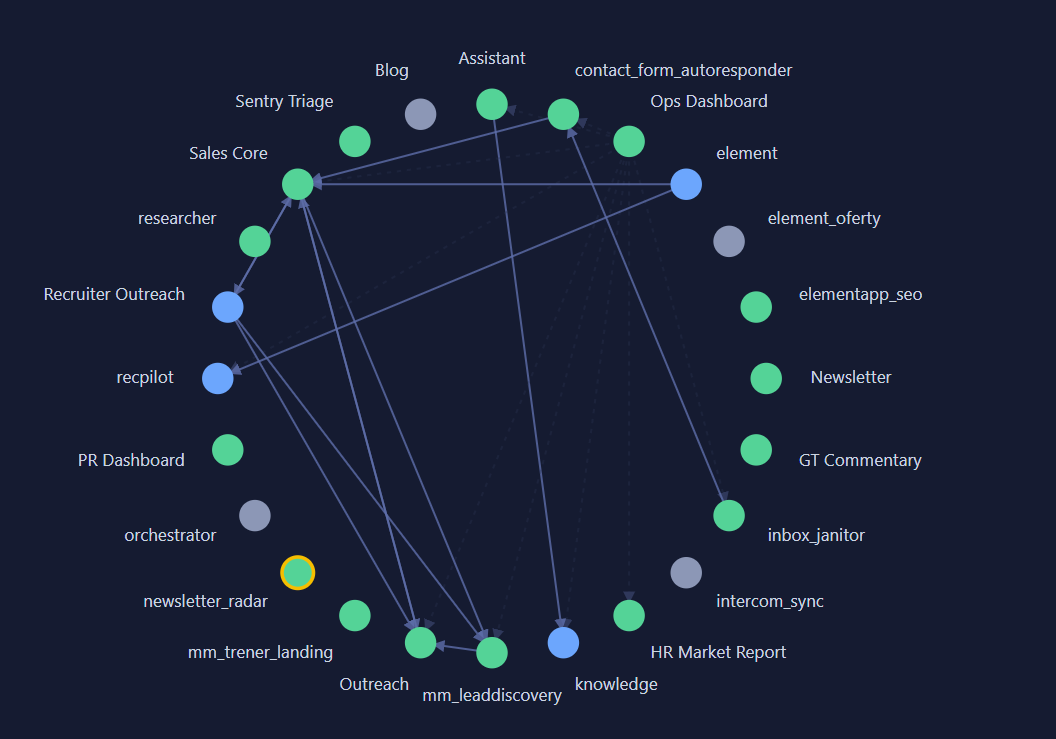
And this is what my current team of agents looks like. There are too many of them for me to talk to each one, so I built an “orchestrator” for exactly that job and now I only talk to it. It knows who to route each instruction to and who to pull answers from for my questions.
My own framework is simple: I automate at two scales at once. On one side, whole business processes end to end; on the other, single repeatable tasks belonging to specific people. It is the same split that Replit’s manager agent runs by spawning many agents in a loop, just shrunk to the size of a micro-team. I teach the same approach in my “AI in office processes” workshop, because the most common barrier is not a lack of technology, it is not knowing which process to start with. If you want help building AI agents or your own autonomous company, get in touch with me.
Where to start building your own autonomous company
If you want to bring this pattern to your own work, do not start by buying an expensive platform. Start with the process and with the agent’s operating loop. A concrete order that works well on a small budget:
- List the tasks you do every week that have a clear goal and a checkable result. Those are the first candidates for automation.
- Pick one such task and write it out along the loop: goal, context needed, work to be done, how the result gets verified, when it escalates to a human.
- Build the simplest possible agent for that one process and add a safety catch right away, for example an action limit or a mandatory approval before anything goes out.
- Instead of paying middlemen for every step, move mature automations onto your own cheap hosting once the process stabilizes.
- Control model costs from the start: use a cheaper model for simple tasks and turn off unnecessary thinking tokens wherever they add no value.
- Only once you have a few working agents, add a control layer: permissions, logs, and a review of what the automations do on your behalf.
- Treat yourself as a director, not a performer. Your most valuable work is choosing the goals and judging the results, not clicking every step.
Replit’s takeaway is that in every one of the examples the human was not automated, they were promoted. The same thing works at the scale of a one-person company: a well-arranged fleet of agents does not take your work away, it gives you back the time for the decisions no automation will make for you.
The autonomous company: frequently asked questions
Does an autonomous company mean laying people off?
Not in the model Replit describes. People still choose the goals, make the hard tradeoffs and take responsibility for the outcome, while agents take over the execution of the steps. In practice people move up from performers to directors who run the work of the automations.
Do I need a big budget to start?
No. The pattern scales down to a one-person business. All it takes is one repeatable process written out along the loop of goal, context, work, verification and escalation, a simple agent, and one safety catch. Your own cheap hosting and a deliberate choice of models keep the costs low.
What is the biggest risk in a company like this?
Agent autonomy without a control layer. That is why verification of the result and escalation to a human are part of the loop, while permissions, limits and audit logging make sure an automation never does anything a person would not have approved.
DISCOVER ELEMENT!
Maciej Michalewski
CEO @ Element. Recruitment Automation Software
Recent posts:

The autonomous company: how Replit does it with AI agents, and how to do it yourself
Replit built an autonomous company: a fleet of AI agents where people choose the goals and automations handle the steps. I break down the pattern and how to run it yourself.

How to reject a candidate without ghosting: Glen Cathey’s playbook
Ghosting applicants isn’t a volume problem, it’s a priority problem. I walk through Glen Cathey’s rejection playbook: 6 rules, 7 templates and ATS setup.

Poland’s job market turns positive: 259,000 postings, all ten cities growing
Poland posted 259,000 job ads in June 2026, the first positive year-over-year reading in more than a year. The Grant Thornton and Element report reads it as a cautious but real turnaround.

What’s new in Element: a month of concrete improvements for recruiters
A roundup of what’s new in Element this month: saved filters, GDPR and consent tracking, candidate SMS, a new public API, and stronger data security.

Career in the age of AI agents: what really counts, per Phil Chen
Phil Chen (Helm AI, Scale, OpenAI, DeepMind) argues that in the age of AI agents, finding problems, the last mile and reputation matter more than solving tasks. A summary plus my HR take.

AI isn’t taking jobs. Companies that invest in it hire more
A Ramp study of 21,599 US firms finds that companies investing seriously in AI grow headcount 10.2% in two years, including entry-level roles. The data pushes back on AI job-loss panic.