A Polish-founded robot that drives screws faster than humans
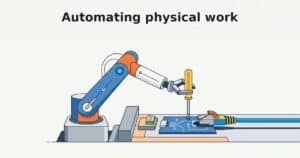
When people think about automation, they usually picture chatbots, image generators, and coding assistants. Meanwhile, AI is moving into territory that seemed off-limits until recently: precise physical work. Physical Intelligence (π), a startup co-founded by Polish-born Karol Hausman, just demonstrated that robots can drive screws, insert ethernet cables, and thread zip ties faster than humans, and not under lab conditions but in tasks requiring sub-millimeter precision.
A kid from small-town Poland who's building a brain for robots
Karol Hausman grew up in a small town in Poland and found his inspiration for robotics where many of us did: Star Wars. That childhood fascination took him to Stanford and Google DeepMind, and eventually to founding Physical Intelligence alongside Sergey Levine and Chelsea Finn, two leading robotics researchers from Stanford. The company wants to build a universal “AI brain for the physical world,” a foundation model that can control any robot on any task. They’ve raised over a billion dollars from investors including Sequoia Capital, Khosla Ventures, and Thrive Capital to make it happen.
15 minutes of training, superhuman precision
Physical Intelligence’s latest achievement is a method called RLT (Reinforcement Learning Tokens), which lets robots rapidly improve at precise manipulation tasks. Here are the results:
- Screwdriver alignment improved from 1.7 to 14 successes per 10 minutes, an 8x increase
- Zip tie threading went from 2.8 to 13 successes per 10 minutes
- Ethernet cable insertion sped up from 147 to 400 successes per 10 minutes
- Power cord insertion jumped from 136 to 600 successes per 10 minutes
One number worth pausing on: the robot needs just 15 minutes of real-world data to start improving, and full training takes about two hours. On ethernet insertion, half of the robot’s attempts were faster than the best human-teleoperated trial. These are tasks requiring sub-millimeter precision that were considered out of reach for machines not long ago.
Laundry, boxes, espresso, and kitchens it's never seen
RLT is the latest step, but π0, Physical Intelligence’s main product, already handles quite a bit more:
- Unloading a dryer, carrying laundry over, and folding it into a stack
- Clearing tables, collecting dishes, and sorting waste into the right bins
- Assembling cardboard boxes with multi-step corrections
- Gently packing eggs into a container
- Grinding coffee and making espresso
The newest version, π0.5, takes this even further. A robot running this model can clean up a completely unfamiliar kitchen or bedroom based on plain-language instructions. The system isn’t programmed for a specific room; it simply adapts, which in practice means the same robot can work in entirely different apartments without any extra configuration. The model runs on eight different robotic platforms, from single UR5e arms to bimanual setups to mobile robots. On shirt folding it hits 100% success where competing models (OpenVLA, Octo) score 0%. One hundred to zero, just to be clear.
Physical Intelligence isn't the only player
Physical Intelligence isn’t working in isolation. The entire physical automation sector is accelerating at the same time:
- Tesla Optimus Gen 3 has new hands with 50 actuators and 22 degrees of freedom per hand, with factory deployment planned for Q2–Q3 2026 and mass production in 2027.
- Figure AI unveiled Figure 03 in late 2025, designed for high-volume manufacturing.
- According to the International Federation of Robotics, the industrial robot market has reached $16.7 billion, while warehouse automation is approaching $30 billion with projections to double by 2030.
- Some logistics companies already run “lights-out” night shifts where robots handle all processes without anyone on site.
The IFR’s top trends for 2026 boil down to two themes: robots are getting smarter through AI, and they’re being deployed to fill jobs that companies can’t hire humans for.
Physical work is no longer "safe" from automation
For years the conventional wisdom held that AI would automate knowledge work but physical work was safe because it requires fine motor skills, adaptation to unpredictable conditions, and “common sense” that machines don’t have. Those arguments are looking less convincing by the month. A Physical Intelligence robot drives an M3 screw with sub-millimeter precision after 15 minutes of learning. It folds laundry it has never seen before. It cleans a kitchen it has never been in. It does all this across different robotic platforms because its “intelligence” isn’t tied to a specific mechanical body but lives in a model you can install on any arm. We’re no longer building robots for single tasks on a production line. We’re building something closer to universal physical intelligence, and a guy from a small Polish town is one of the people making it happen. At the current pace of progress, I suspect that a year from now we’ll wonder why we ever doubted machines could do this.
DISCOVER ELEMENT!
Maciej Michalewski
CEO @ Element. Recruitment Automation Software
Recent posts:

A Polish-founded robot that drives screws faster than humans
A Polish-founded robot that drives screws faster than humans When people think about automation, they usually picture chatbots, image generators, and coding assistants. Meanwhile, AI
People prefer AI poetry over Shakespeare
A study published in Scientific Reports (Nature) produced results that should interest anyone who thinks human creativity is easy to tell apart from machine output.
Three tools that measure AI’s impact on the job market
The debate about AI’s impact on the job market has been going on for years, but it only recently moved past the “experts predict” stage.

Poland’s job market: 238,000 offers and the specter of jobless recovery
In February 2026, Polish employers posted 238,000 job offers – 7% fewer than last year. Analysis of the Grant Thornton report and Element CEO commentary.


HR services market in Poland 2025 – key findings from the PFHR report
Polskie Forum HR has published its annual report on the condition of the HR services market in Poland. Element is a technology partner of PFHR,

I Don’t See a Future for MS Office
Three phases of transition from clicking buttons to AI commands. Why Microsoft Office in its current form is destined to disappear.