

3 seconds is enough to screen candidate’s Linkedin profile. Eye tracking research results.
The first stage of the candidate screening usually consists of reviewing the CV or Linkedin profile. Such a preliminary analysis takes an experienced recruiter from a few to several dozen seconds. Therefore, it is not an exaggeration to say that the fate of a candidate is decided in literally seconds. Someone with no recruitment experience could ask – are several seconds enough to correctly screen candidates’ profiles?
The purpose of screening is to exclude candidates that do not meet the recruitment process’s essential criteria. Analyzing a few dozen, sometimes several hundred words that make up a typical candidate’s profile, focusing primarily on the description of professional skills and experience, is indeed a matter of seconds, not minutes for a professional recruiter.
The screening time is naturally shorter if we have fewer criteria to look for and if a candidate’s profile has a short content. In extreme cases, when a very short profile is analyzed, a recruiter’s decision is made literally in 3 seconds.
As an example, we present below the results of the eye tracking analysis of two profiles by an experienced recruiter. The research was conducted in connection with Element‘s development. Element is an ATS (from applicant tracking system). You can read a bit more about this eye tracking research, and even see us in special eye tracking equipment, here.
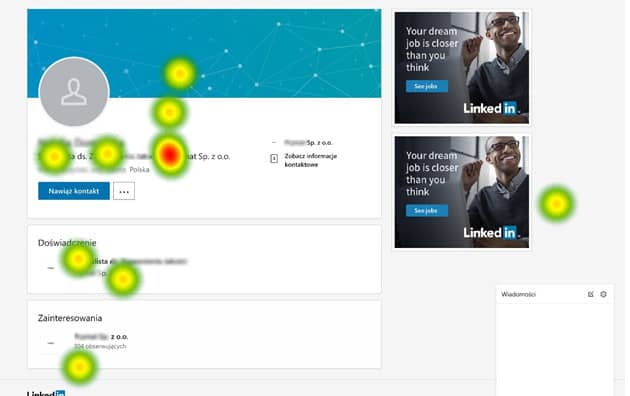
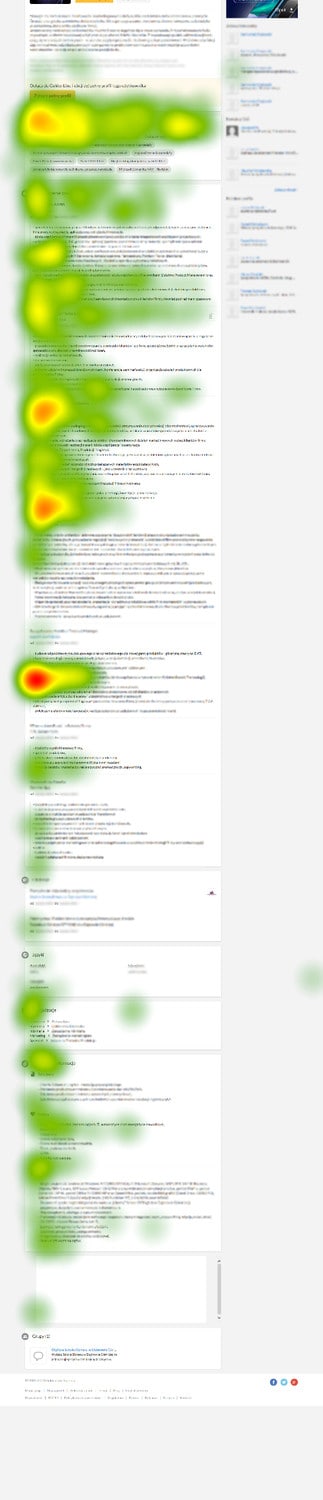
The results of the research are presented in the form of heat maps. The study follows the recruiter’s vision during candidate’s profile analysis. Thanks to this, we know in what order the candidate’s profile elements are analyzed by the recruiter and how long it takes to examine particular aspects and the profile. You can see red spots on the heat map —these mark elements, on which the recruiter’s eyesight has focused the longest.
The first profile is lacking most of the important information. Recruiter analyzed the profile for about 3 seconds:
The second profile is well completed and belongs to an experienced candidate. The analysis took the recruiter a few dozen seconds:
Conclusions:
- A well-filled profile is an absolute basis for drawing the recruiter’s attention for more than a few seconds.
- An efficient recruiter needs several to several dozen seconds to decide whether a profile meets the basic requirements for the recruitment process.
- Description of professional experience is the most important, and this element is prioritized in screening.
Related posts:
Maciej Michalewski
CEO @ Element. Recruitment Automation Software
Recent posts:

The Automated Company, part 1: why we are building a company run by AI
Part 1 of The Automated Company series: why Element hands routine work to automation and where people still make the decisions.

Element races ahead: Slack, default filters and global template updates
We had barely refreshed Element’s look when a Slack integration, default filters, global message template updates and adding candidates straight from a CV arrived.
Element’s new look: another job done well by AI agents under human supervision
Element has a new look: Material 3 on top of a frontend rewritten from Angular 13 to 18, with 181 of 182 code changes made by AI agents under human supervision.

Job offers in Poland, August 2026: more ads, fewer jobs
Poland posted 257,046 new job ads in August 2026, up 4% year over year, even as employment in the enterprise sector fell. Data from the Grant Thornton report and my take.

Does an ATS Reject CVs? The Truth Looks Different
Short answer: no. No ATS I’ve ever worked with, Element included, has a function that reads a CV and automatically rejects a candidate. What an
Fields and tags in Element: a system that fits a small firm and an international one
A new way to use fields and tags in Element. Unlimited fields, tags on user accounts too, and one switch that turns a tag group into a boundary in your candidate database.
See for yourself why recruitment companies trust us.
Sign up for the demo.
We will contact you ASAP to propose a date for a presentation of the Element system.