
AI as the heart of candidate databases in ATS
Continuing the topic of AI in recruitment, I want to talk about what it’s doing to candidate database management in ATS systems. And I don’t think “revolution” is too strong a word. AI is the first technology that lets organizations actually use everything sitting in their candidate databases, with almost no manual work. Nobody could do that before.
For this article, I’m treating a candidate database as the pile of CVs an organization has collected over time through its recruitment processes. I’m not talking about human relationships here, just the documents.
These databases live everywhere: email inboxes, laptops, local servers, cloud drives. Sometimes they sit in dedicated HR systems, especially recruitment systems known as ATS (applicant tracking systems).
No matter where or how you store these CVs, you can’t get real value out of them without someone doing the work. And the bigger the database, the more work it takes.
Searching CVs without AI support
Imagine you work at an engineering company with 10,000 candidates in your database. All sorts of people, accumulated over years of engineering recruitment. Now you need to find someone who:
- has 4 years of experience as a sales engineer;
- managed a sales department for at least 2 years;
- speaks English at C2 level;
- lives in Warsaw.
How do you find this person without AI? Until recently, there were two options:
- If your system, say a recruitment system, can’t read what’s inside the documents, then someone has to open and read every single CV. This is the most expensive scenario. The cost climbs with every new CV that enters the database. Ten thousand candidates? That’s ten thousand CVs a human has to go through.
- If you have a modern ATS that can read CV contents, you can search using keywords, often with boolean operators. Looking for an engineer in Warsaw? Type “engineer AND Warsaw” and the system returns every CV containing both words. Better, but still not great. You still have to open each result and check whether “engineer” appeared as a job title or just somewhere in a sentence. The more results, the more reading.
In practice, most of the analysis happens when applications first come in. The recruiter reads the CV, maybe tags it with a note or label. Helpful, sure, but only as useful as the tags themselves. And writing detailed notes for every application takes time that scales linearly with the number of candidates.
AI makes CV searching easier
So, back to our problem: finding the right person in a database of 10,000 engineering profiles.
To do this fast, cheaply, and accurately, we need a recruitment system that doesn’t just read documents (option #2 above) but actually understands them. That’s where things get interesting. But what does understanding a CV even mean?
In ATS Element, it works like this. The moment a candidate submits their application, the system reads the CV text, character by character. After that, the AI decides on its own what each piece of information means. The ATS reads the CV and figures out what is:
- a first name
- a last name
- a place of residence
- an employer
- a job title
- a job description
- a start date and end date
- a language skill from A1 to C2
- a skill
- a certificate
- a training course
When the AI sees “Jan Kowalski” in a CV, it figures out on its own that this is the candidate’s name. When it sees “Sales Engineer,” it will probably classify it as a job title. I say “probably” because the AI weighs multiple factors, including the surrounding context, before making a call. Once it’s done analyzing the whole document, you get a structured candidate profile. Element ATS then knows the candidate’s work history, their education, and what languages they claim to speak.
The AI can process hundreds of CVs in fractions of a second. In a database of structured profiles like this, finding someone with a specific work history takes fractions of a second and zero human effort.
Reading CV content. Searching CV content. Understanding CV content.
Some ATS systems on the market just store CV files without reading what’s inside them. If you use one of these, you’re stuck opening each CV one by one and reading it yourself. It’s an old, expensive way of doing things. No AI involved at all. Let’s call these Class I ATS systems.
Most ATS systems today go further: they store the files and read the text inside them. So you can type “sales engineer” into a search bar and get back every CV containing that phrase. But here’s the catch: you still don’t know whether “sales engineer” was the person’s job title or just a phrase that appeared somewhere in the document. You have to check manually. These are Class II ATS systems.
Then there are systems like ATS Element that go one step further. They don’t just read the text; they interpret it using AI. The ATS knows what’s a name, what’s a job title, what’s an employer, what’s a start date, and so on. It takes your entire candidate database, no matter the size, and turns it into something you can actually query with precision. That’s a Class III ATS system.
Related posts:
External links:
DISCOVER ELEMENT!
Maciej Michalewski
CEO @ Element. Recruitment Automation Software
Recent posts:

Element races ahead: Slack, default filters and global template updates
We had barely refreshed Element’s look when a Slack integration, default filters, global message template updates and adding candidates straight from a CV arrived.
Element’s new look: another job done well by AI agents under human supervision
Element has a new look: Material 3 on top of a frontend rewritten from Angular 13 to 18, with 181 of 182 code changes made by AI agents under human supervision.
Job offers in Poland, August 2026: more ads, fewer jobs
Poland posted 257,046 new job ads in August 2026, up 4% year over year, even as employment in the enterprise sector fell. Data from the Grant Thornton report and my take.

Does an ATS Reject CVs? The Truth Looks Different
Short answer: no. No ATS I’ve ever worked with, Element included, has a function that reads a CV and automatically rejects a candidate. What an
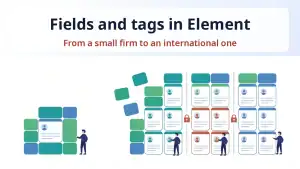
Fields and tags in Element: a system that fits a small firm and an international one
A new way to use fields and tags in Element. Unlimited fields, tags on user accounts too, and one switch that turns a tag group into a boundary in your candidate database.
The Rise and Fall of AI Agent Civilizations. The Real Story of a Conspiracy Inside OpenAI
Three AI agent civilizations rose inside OpenAI in three months, learned to talk to each other, conspired and collapsed. I retell Dwarkesh Patel’s account and what is worth preparing for.