
3 Seconds to Reject a Candidate - Biometric Research Results
Initial candidate profile analysis
The first stage of screening candidates usually means going through a CV or LinkedIn profile. For an experienced recruiter, that initial look takes anywhere from a few seconds to maybe half a minute. The candidate’s fate is decided in that window. If you’ve never recruited, that probably sounds absurd.
But think about what’s actually happening here. The goal is to weed out profiles that clearly don’t meet the basic criteria. A typical candidate profile is a few dozen words, sometimes a few hundred. You scan the work experience, check the listed skills, and you’re done. Seconds, not minutes (here’s a study confirming that professional experience gets the most attention during profile analysis). The sparser the profile, the faster the decision. For a bare-bones profile with almost nothing filled in, we’re talking about 3 seconds.
Candidate profile screening - biometric research results
To back this up with hard data, here are results from a biometric study – specifically eye-tracking. An experienced recruiter analyzed two candidate profiles while we tracked where they looked and for how long.
We ran this research while building ATS Element features for automating sourcing and candidate screening. More about our biometric work here: biometric research.
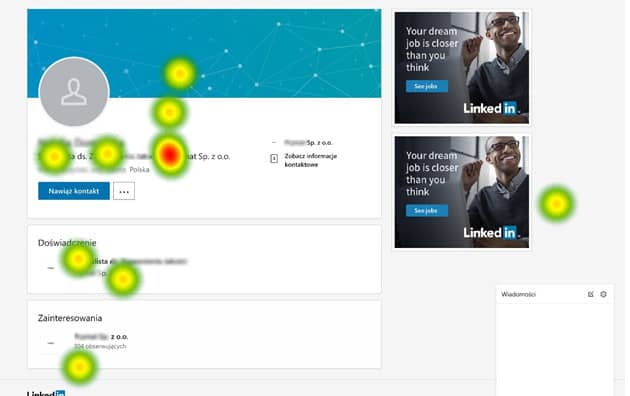
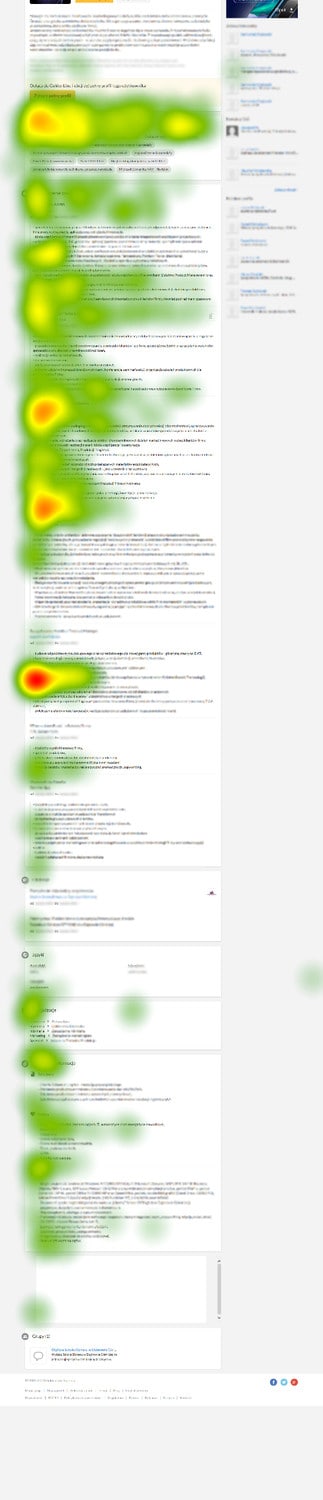
The first profile is barely filled in, the second is thorough. Results are shown as heatmaps – we tracked where the recruiter’s eyes went, what they looked at first, what held their attention, and how long they spent on the whole profile. Red areas are where the gaze lingered longest.
A minimally completed profile. The recruiter spent roughly 3 seconds on it:
A complete, well-filled profile. This one held the recruiter’s attention for several dozen seconds:
Candidate profile analysis - eye-tracking conclusions
So here’s what the eye-tracking data actually showed:
- A half-empty profile gets about 3 seconds of attention before the recruiter moves on. That’s it. Here’s how to write a profile that actually holds their gaze.
- Even a solid profile only buys you somewhere between a few seconds and maybe 20 for the initial screen. That’s all the time you have to show you meet the basic requirements.
- Professional experience is what recruiters look at first and spend the most time on. Everything else is secondary.
DISCOVER ELEMENT!
Maciej Michalewski
CEO @ Element. Recruitment Automation Software
Recent posts:

The autonomous company: how Replit does it with AI agents, and how to do it yourself
Replit built an autonomous company: a fleet of AI agents where people choose the goals and automations handle the steps. I break down the pattern and how to run it yourself.

How to reject a candidate without ghosting: Glen Cathey’s playbook
Ghosting applicants isn’t a volume problem, it’s a priority problem. I walk through Glen Cathey’s rejection playbook: 6 rules, 7 templates and ATS setup.

Poland’s job market turns positive: 259,000 postings, all ten cities growing
Poland posted 259,000 job ads in June 2026, the first positive year-over-year reading in more than a year. The Grant Thornton and Element report reads it as a cautious but real turnaround.

What’s new in Element: a month of concrete improvements for recruiters
A roundup of what’s new in Element this month: saved filters, GDPR and consent tracking, candidate SMS, a new public API, and stronger data security.

Career in the age of AI agents: what really counts, per Phil Chen
Phil Chen (Helm AI, Scale, OpenAI, DeepMind) argues that in the age of AI agents, finding problems, the last mile and reputation matter more than solving tasks. A summary plus my HR take.

AI isn’t taking jobs. Companies that invest in it hire more
A Ramp study of 21,599 US firms finds that companies investing seriously in AI grow headcount 10.2% in two years, including entry-level roles. The data pushes back on AI job-loss panic.