

Job offers in Poland, July 2026: the market grows for a second month, but IT stands still
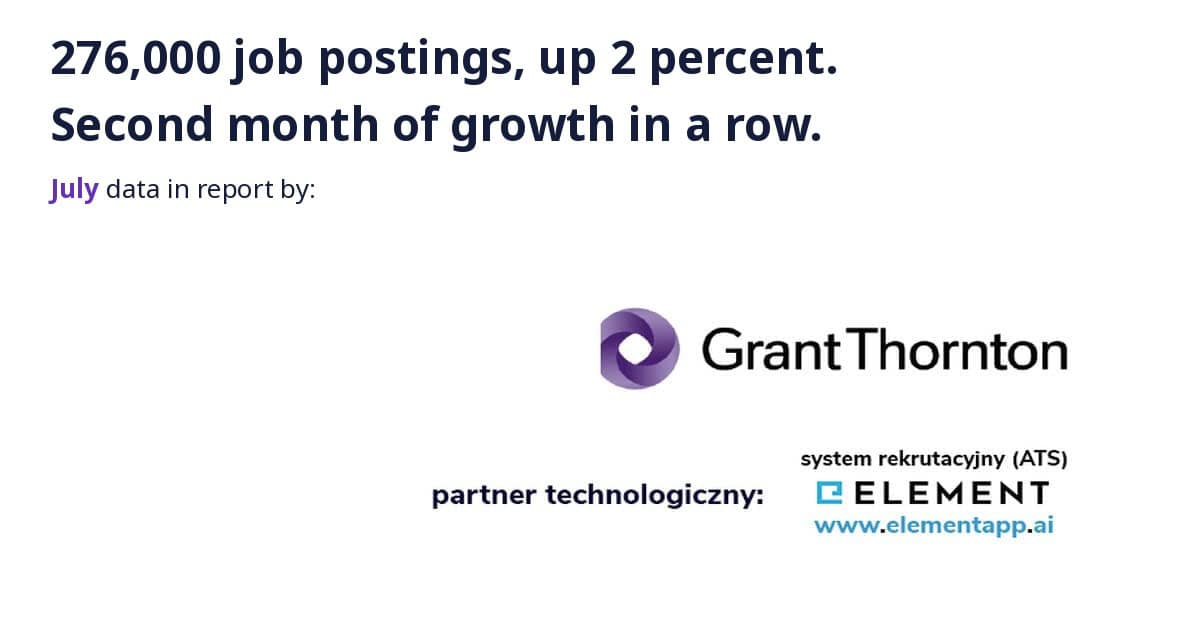
In July 2026, employers posted 275,623 new job ads across the 50 largest recruitment portals in Poland, 2% more than a year earlier. That is the second consecutive month of positive year-over-year growth. The latest, 73rd edition of Grant Thornton’s “Job Offers in Poland” report, prepared with Element as the technology partner, shows the rebound starting to take hold. In the previous edition, covering June 2026, the yearly dynamic reached 4%, so July’s reading is lower, even though the three-month rolling average moved up. Below are the key data from the report and my take. Note: the full report is a Polish-language PDF, so keep that in mind before you click through. If you read Polish, you can also read the Polish version of this article.
Key data from the report
July 2026 marked the second straight month of positive year-over-year growth. Employers published 275,623 ads, 4,643 more than in July 2025, when the market delivered 271,000 offers. The yearly dynamic came in at 2%, below June’s 4%, while the three-month rolling average, which smooths out the volatility of monthly data, rose from 1% to 2%. Month over month, the market grew by as much as 7%, or 16,943 offers.
These two numbers have to be read together, because on their own they mislead. A lower yearly dynamic looks like a slowdown, but the rising three-month average shows the opposite: this is no longer a one-off; it is becoming a pattern. May brought the dynamic back to zero after a long run of declines, June turned clearly positive, and July held that gain. Caution is still warranted, because persistent economic uncertainty in Poland and globally can slow the pace of improvement, and only the autumn will show whether the rebound lasts.
Cities: seven out of ten in positive territory
In June all ten monitored metro areas grew year over year, and in July the picture is more uneven. Seven cities recorded growth, with the strongest gains in Wroclaw (+9%), Poznan (+7%) and Warsaw (+5%). Gdansk (-2%) was the only city in negative territory, while Lodz and Bydgoszcz closed the month flat. Large cities usually run ahead of the broader market trend, so I will check in August whether Gdansk, Lodz and Bydgoszcz come back to growth.
| City | New offers VII 2026 (thousands) | YoY change | Offers per 1,000 residents |
|---|---|---|---|
| Warsaw | 45.9 | +5% | 24.7 |
| Krakow | 17.9 | +2% | 22.2 |
| Wroclaw | 14.7 | +9% | 21.8 |
| Gdansk | 10.6 | -2% | 21.9 |
| Poznan | 10.3 | +7% | 19.2 |
| Katowice | 6.9 | +1% | 25.0 |
| Lodz | 5.4 | 0% | 8.3 |
| Szczecin | 4.8 | +4% | 12.5 |
| Lublin | 3.9 | +3% | 12.1 |
| Bydgoszcz | 3.4 | 0% | 10.5 |
Per thousand residents, the largest cities averaged 17.8 offers. Katowice kept the lead at 25.0, with Warsaw just behind at 24.7. Lodz again came in lowest at 8.3 offers per thousand people, even though 5,400 ads were published there in absolute terms. Bydgoszcz delivered the fewest offers in absolute numbers, just 3,400, which is exactly the same as a year earlier.
Industries: healthcare pulls the market, IT stands still
All seven monitored industries stayed flat or positive, but the spread between them is the widest in months. Healthcare grew by 13%, from 2,940 to 3,320 offers, and is the only industry with double-digit growth. At the other end sits IT with 1,542 offers, exactly the same number as in July 2025. As recently as June that same industry was growing by 9%, so the stall is a real change rather than a rounding effect.
| Industry | YoY dynamics | My take |
|---|---|---|
| Healthcare | +13% | Staff shortages and an aging population |
| Finance | +3% | Steady, repeatable demand for accounting and controlling |
| HR | +3% | More recruitment means more recruiters |
| Legal | +3% | Continuation of June’s rebound |
| Marketing / Sales | +1% | Cautious budgets and slower decisions |
| Blue-collar | +1% | The largest volume on the market, slow recovery |
| IT | 0% | The same number of offers as a year ago |
Blue-collar work remains the largest slice of the market, at 23,011 postings against 22,702 a year earlier, but that one percent adds up to just 309 new postings, fewer than the 380 healthcare added, even though healthcare’s base is seven times smaller. Finance, HR and legal each grew by 3%, marketing and sales by 1%. The market is therefore growing broadly, just very unevenly.
Benefits and requirements: both lists shorter than they used to be
The average number of benefits per offer came in at 5.6 in July, close to the June level. That is a low reading against previous years, when the figure held in the 6.5 to 6.7 range. The most frequently offered benefit remains a medical package, present in 59% of offers, followed by a sports package at 56% and training at 50%. Employers promise high pay in 28% of ads and flexible working hours in 25%.
On the requirements side the list also got shorter, down to 4.8 conditions per offer, from 5 in June 2026. Professional experience remains the most common expectation, required by 65% of employers, with education second at 52%. Availability appears in 29% of ads and foreign-language skills in 25%. Three of the four most common requirements fell against June, when 69% of employers expected experience and 53% expected education. Foreign-language skills dropped the most, from 35% to 25%, while availability was the only one to tick up, from 28% to 29%. Both lists are shorter today than they were in earlier years, which points to a market that has stopped competing on perks but is not raising the bar for candidates either.
My take: what is growing is what artificial intelligence touches least
I am glad to see growth return. What tells me the most is not the size of the increase but where it lands. Healthcare grew the fastest of all industries, while IT has exactly as many offers as a year ago, 1,542 in July 2025 and 1,542 in July 2026. The same split shows up in data from the United Kingdom. The June LinkedIn Economic Graph report “The UK Labour Market: Unlocking Growth in the Age of AI” shows that British technology hiring is 30% below pre-pandemic levels, professional services 28% below, and manufacturing 35% below. The only sectors back at or near where they were before the pandemic are education, hiring 10% above that level, and healthcare, within a single percentage point of it. These are two different markets, but the dividing line runs through both in the same place.
More than the business cycle is driving that split. Challenger, Gray & Christmas counted 33,429 job cuts announced by American employers in July 2026, and artificial intelligence was the leading reason with 10,970 of them, roughly a third of the month’s total and the fifth such result in a row. Cumulatively in 2026, AI has been cited in 112,713 cuts, about 24% of the total. I would not map those numbers straight onto Poland, because our market is built differently and reacts with a lag, but I find them hard to ignore while I look at an IT sector that has come to a stop after a month of nine percent growth.
For months I have been saying that artificial intelligence is pushing juniors out of the market, and I now have to narrow that claim. The same LinkedIn report shows that in the United States, the United Kingdom, France, Germany and India, hiring for entry-level roles is falling at roughly the same pace as the market overall, so there is simply no broad collapse. What is actually happening is narrower and, to my mind, more dangerous: in British roles where AI has genuinely entered daily work, entry-level hiring fell by 13% year over year against 6% for the market as a whole, more than twice as fast. Our Polish rebound happens to be taking place in the industries that this mechanism touches least, healthcare and blue-collar work, so it tells us very little about the next stage. That is why at Element I now watch not the total number of offers but the occupations they appear in, because only that structure reveals what is really happening.
Download the report
You can download the full report, “Job Offers in Poland. Edition LXXIII: July 2026,” with commentary from Magdalena Marcinowska (Grant Thornton) and myself, below. Note: the report itself is written in Polish only.
The report includes:
- full monthly data and year-over-year comparisons,
- an analysis of roles across seven major industries,
- charts on benefit and requirement trends,
- a ranking of the ten largest metro areas,
- commentary from Grant Thornton and Element experts.
Read more about ATS at Element here.
DISCOVER ELEMENT!
Maciej Michalewski
CEO @ Element. Recruitment Automation Software
Recent posts:

Job offers in Poland, July 2026: the market grows for a second month, but IT stands still
Poland posted 275,623 new job ads in July 2026, up 2% year over year. Healthcare grew fastest of all sectors while IT did not move at all.

The autonomous company: how Replit does it with AI agents, and how to do it yourself
Replit built an autonomous company: a fleet of AI agents where people choose the goals and automations handle the steps. I break down the pattern and how to run it yourself.

How to reject a candidate without ghosting: Glen Cathey’s playbook
Ghosting applicants isn’t a volume problem, it’s a priority problem. I walk through Glen Cathey’s rejection playbook: 6 rules, 7 templates and ATS setup.

Poland’s job market turns positive: 259,000 postings, all ten cities growing
Poland posted 259,000 job ads in June 2026, the first positive year-over-year reading in more than a year. The Grant Thornton and Element report reads it as a cautious but real turnaround.

What’s new in Element: a month of concrete improvements for recruiters
A roundup of what’s new in Element this month: saved filters, GDPR and consent tracking, candidate SMS, a new public API, and stronger data security.

Career in the age of AI agents: what really counts, per Phil Chen
Phil Chen (Helm AI, Scale, OpenAI, DeepMind) argues that in the age of AI agents, finding problems, the last mile and reputation matter more than solving tasks. A summary plus my HR take.