

AI and the Developer Job Market — Doom Myth vs. Data

Is AI Taking Developer Jobs? A Citadel Securities Analysis

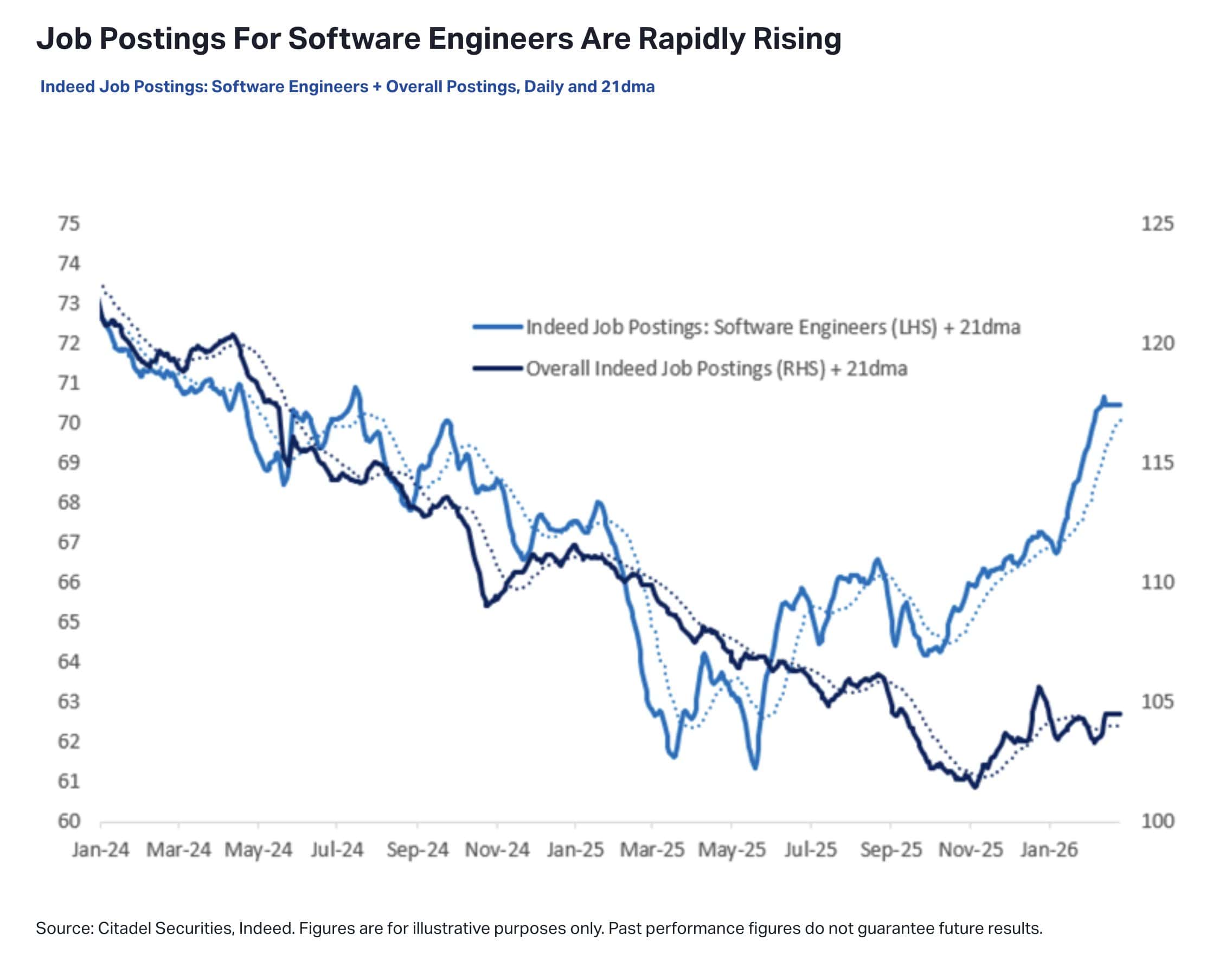
Software engineering job postings are rising 11% year-over-year. US unemployment sits at 4.28%. AI capital expenditure represents 2% of GDP — roughly $650 billion. There are 2,800 new data centers under construction. And yet, the media keeps telling us that “developers are finished.” Time to look at the data instead of the headlines.

In February 2026, Frank Flight of Citadel Securities published “The 2026 Global Intelligence Crisis” — a systematic takedown of the most popular myths about AI and the job market. Meanwhile, David Shapiro, an AI researcher and author of a popular YouTube channel on post-labor economics, points to hidden long-term risks worth considering. Let’s examine both perspectives.

Part 1: The Citadel Securities Analysis — Why the Panic Is Premature

AI Adoption Is Stable, Not Exponential

Flight’s most important argument rests on data from the St. Louis Fed Real Time Population Survey. Daily AI use for work remains stable — no sudden inflection points, no dramatic acceleration. This is a completely different picture than the one painted by media outlets suggesting “AI is taking over everything overnight.”

Flight emphasizes: the data presents “little evidence of any imminent displacement risk.” Technology adoption in the workplace is an evolutionary process, not a revolutionary one.

The S-Curve — Recursive Technology ≠ Recursive Adoption

Technological diffusion has historically followed predictable S-curves: a slow initial phase, acceleration in the middle, then deceleration. Why? Because organizational integration costs, emerging regulations, and diminishing marginal returns all stand in the way.

Just because AI models improve exponentially doesn’t mean companies will deploy them exponentially. Organizations have their own pace of change — employee training, process redesign, compliance. The history of steam engines, electrification, and computerization tells the same story: every revolutionary technology needed decades for full deployment.

The Compute Cost Ceiling

Flight identifies a critical economic constraint: displacing white-collar work “would require orders of magnitude more compute intensity” than current utilization. As automation demand grows, so do marginal compute costs. There exists a natural point where compute costs exceed human labor costs — and at that point, substitution simply doesn’t pay.

This is an argument rarely discussed: AI doesn’t operate in an economic vacuum. When replacing a human with a machine costs more than employment — companies simply won’t do it.

Productivity = Positive Supply Shock

AI-driven automation represents a positive supply shock — it lowers marginal costs, expands potential output, and increases real income. Historically, such shocks have proven disinflationary and growth-enhancing.

The pattern has repeated since the Industrial Revolution: new technology → lower costs → more products and services → new markets → new jobs. AI is no exception — at least for now.

Keynes and the 15-Hour Workweek

Flight references John Maynard Keynes’ famous 1930 prediction that productivity growth would reduce the workweek to fifteen hours by the twenty-first century. Keynes was “directionally correct about productivity growth,” but he failed to predict one thing: humanity chose to consume dramatically more rather than work less. Rising productivity lowered costs and expanded the consumption frontier.

We’re seeing the same pattern today — AI boosts productivity, but instead of reducing work, it creates new areas to fill.

The chart above, based on Indeed data, shows that job postings for software engineers are rapidly rising — up 11% year-over-year — despite the widespread narrative about AI replacing developers.

Part 2: David Shapiro's Perspective — The "Missing Millions"

David Shapiro is an AI researcher, author of books on post-labor economics, and creator of a popular YouTube channel dedicated to artificial intelligence. His perspective complements the Citadel analysis with important long-term caveats.

Rising Job Postings = Broadening Demand for Software

Shapiro highlights a nuance that gets lost in surface-level data reading. The rising number of software engineer job postings doesn’t necessarily mean the industry simply needs more programmers in the traditional sense. Rather, it reflects the fact that the world needs dramatically more software.

AI lowers the barrier to entry — smaller companies that previously couldn’t afford development teams can now build digital products. New businesses are forming faster than ever. This isn’t growing demand for the same work — it’s a broadening of what “software” can solve.

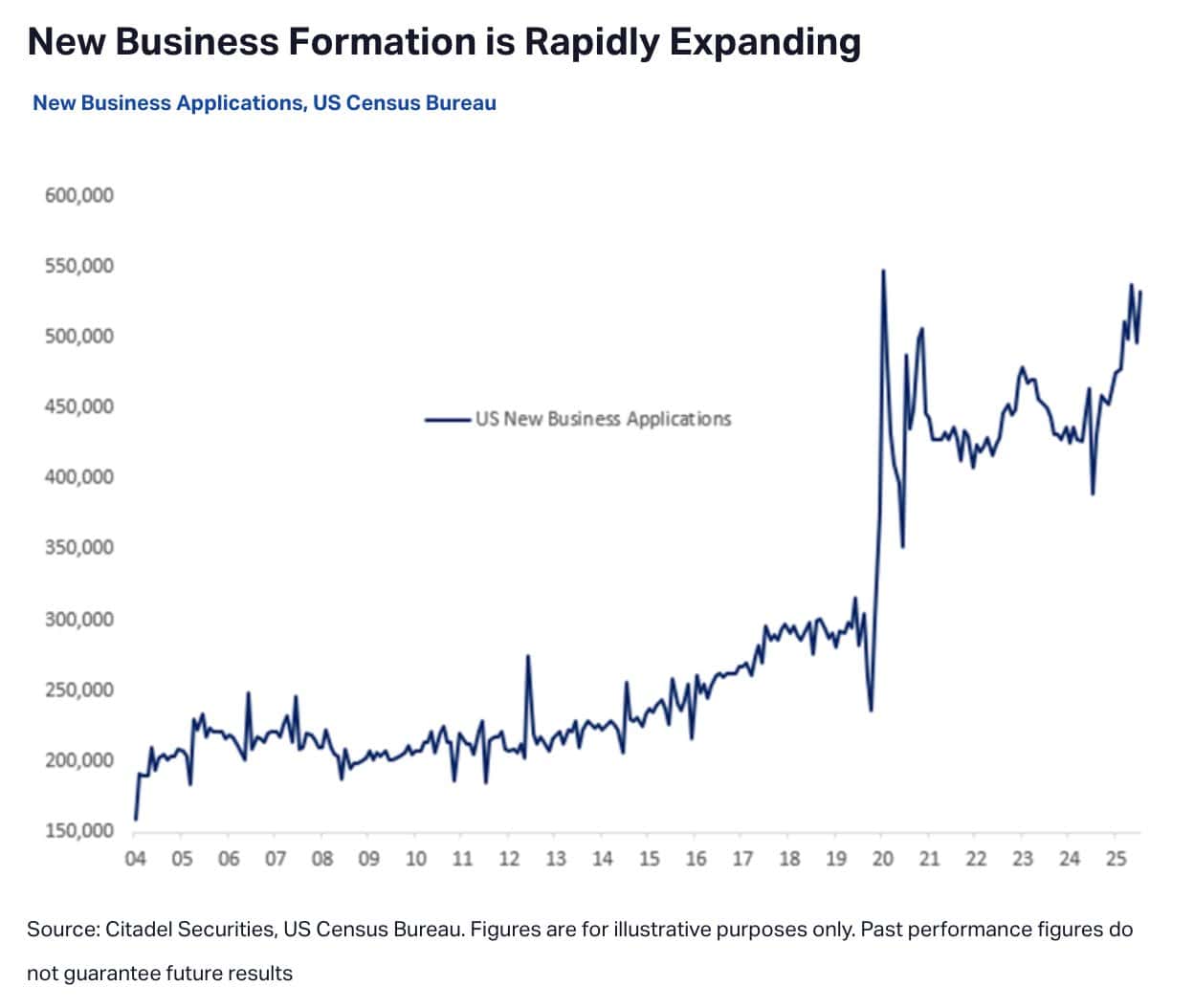
US Census Bureau data confirms it: new business formations are expanding rapidly. Every one of these businesses needs software — websites, apps, automation. This drives demand for developers, but simultaneously changes the nature of their work.

Productivity Growing Faster Than Employment — The "Disappearing Ladder"

Here Shapiro raises the critical question: what happens when the current unmet demand for software becomes saturated? Productivity is growing faster than employment. One developer with AI does today what three did without it. This means the “ladder” into the profession is gradually disappearing.

Shapiro draws a comparison to US manufacturing: over the past 50 years, industrial output tripled, but jobs in the sector were cut in half. For years nobody noticed, because productivity growth compensated for employment decline. Until one day, there was nothing left to compensate.

When Saturation Arrives — The Fallout Will Be Irrevocable

The manufacturing analogy is key here. When the world saturates its demand for software — and that moment will come — a structural shift will occur. Developers who were absorbed by growing demand will suddenly find themselves in a situation where one AI-augmented position replaces several traditional ones.

Shapiro warns: this process, once it begins, will be irrevocable. You cannot “undo” productivity gains. Companies won’t go back to hiring five people where one person with AI does the same work.

Conclusions: Both Perspectives Are Right

Frank Flight of Citadel Securities and David Shapiro are looking at the same market from different time horizons — and both are right.

In the short to medium term (next 2-5 years): the data is clear. Developer demand is growing. AI is complementary, not substitutive. New businesses are forming faster than ever, and each one needs software. The panic is premature.

In the long term (5-15 years): Shapiro’s warning deserves attention. When AI productivity outpaces the creation of new markets, a structural shift will follow. The manufacturing analogy is too apt to ignore.

What does this mean for developers? Learn to use AI — don’t fight it. Invest in skills that AI won’t replace: business understanding, systems architecture, human communication. Be the one steering the tool, not the one the tool replaces.

The developer job market isn’t dying. But it’s changing — faster than ever before.

Read more about ATS and Element here.

DISCOVER ELEMENT!

Fast, agile and user-friendly ATS created by recruiters for recruiters
Picture of Maciej Michalewski

Maciej Michalewski

CEO @ Element. Recruitment Automation Software

Facebook
Twitter
LinkedIn

Recent posts: