

Postings up 11%, Dorsey cuts 40%. What's going on with dev jobs?

The data that surprised me

I’ve been writing about work automation for years. I consider it inevitable and, in the long run, beneficial. So when I came across Citadel Securities’ analysis of AI’s impact on the developer job market, I expected confirmation of what I keep saying: AI is changing the labor market quickly and deeply.

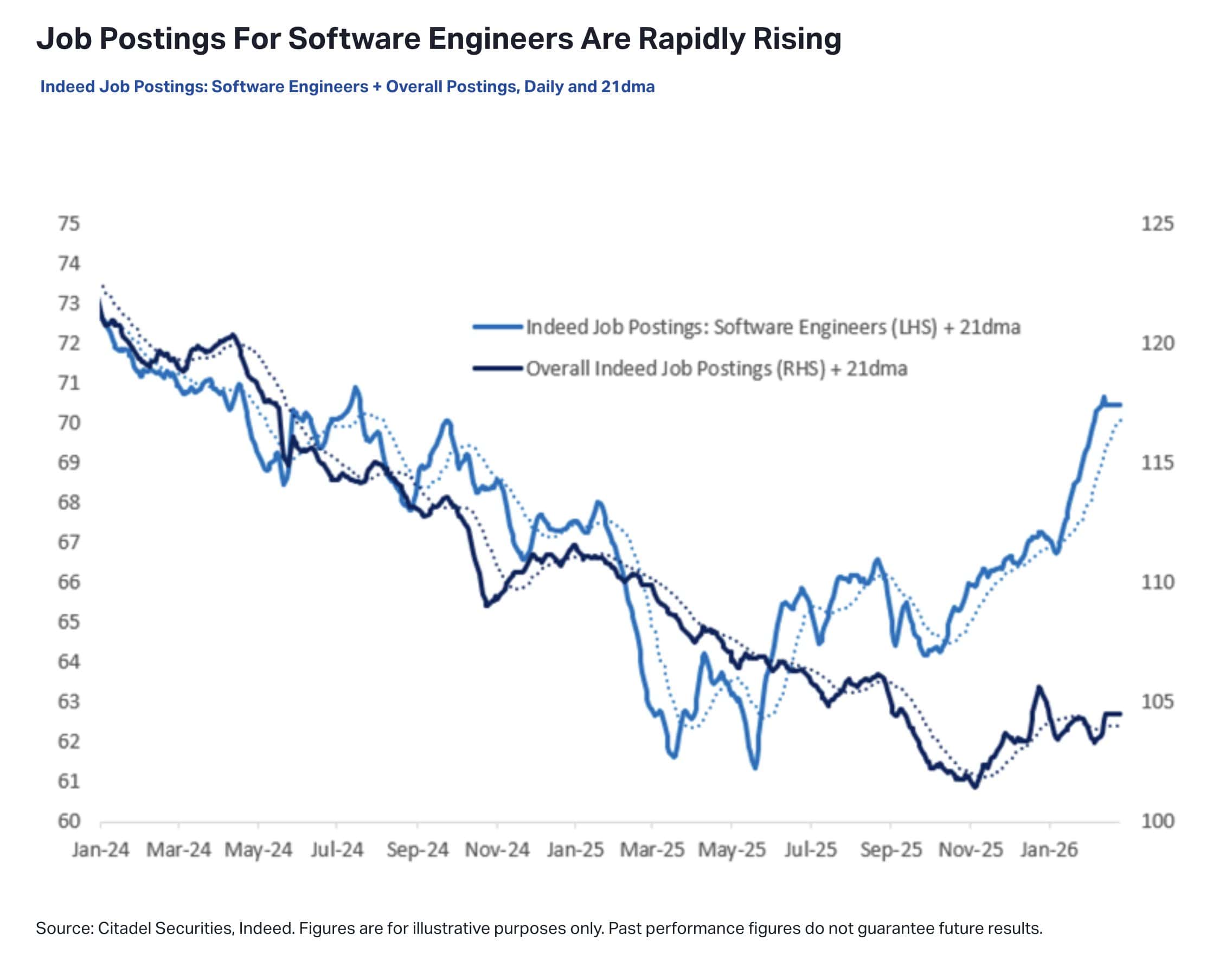
Instead, the data tells a different story. Software engineering job postings are up 11% year-over-year. US unemployment sits at 4.28%. There are 2,800 new data centers under construction. AI spending has reached $650 billion, or 2% of US GDP. And developers? They’re doing better than a year ago.

Frank Flight, Citadel Securities: "The panic is premature"

In February 2026, Frank Flight of Citadel Securities published “The 2026 Global Intelligence Crisis”, a systematic takedown of the most popular myths about AI and the job market. As someone who actively promotes automation, I have to admit his arguments are solid.

AI adoption is stable, not exponential

This is probably the most surprising point in the whole analysis. Data from the St. Louis Fed Real Time Population Survey shows that daily AI use for work remains stable. No sudden jumps, no inflection points. We AI enthusiasts live in a bubble. We test every new tool, automate everything we can. But the rest of the world is adopting AI slowly, at its own pace.

Flight writes plainly: the data presents “little evidence of any imminent displacement risk.” That sentence sounds strange coming from someone at Citadel Securities, but it’s backed by numbers.

The S-curve, or why recursive technology ≠ recursive adoption

This argument hits hardest for me. Just because AI models improve exponentially doesn’t mean companies will deploy them exponentially. Technological diffusion has historically followed an S-curve: slow start, acceleration, then deceleration. Employee training, process redesign, compliance, organizational resistance. Things no benchmark will speed up.

Steam engines, electrification, computerization. Each needed decades for full deployment. I don’t see why AI should be different.

The compute cost ceiling

Flight points to something rarely discussed. There’s a natural economic ceiling on automation. Displacing white-collar work “would require orders of magnitude more compute intensity” than current utilization. The more you automate, the more expensive the next percent of automation becomes. When compute exceeds the cost of human labor, substitution simply doesn’t pay.

AI doesn’t operate in an economic vacuum. This ceiling is real and underappreciated.

Productivity as a positive supply shock

AI-driven automation lowers marginal costs, expands potential output, and increases real income. Historically, these kinds of shocks have been disinflationary and growth-friendly. The pattern repeats from the Industrial Revolution onward: new technology lowers costs, more products get built, new markets open up, and new jobs follow.

Keynes and the 15-hour workweek

Flight references Keynes’ 1930 prediction that productivity growth would reduce the workweek to fifteen hours. Keynes was right about productivity, but he didn’t predict that humanity would rather consume more than work less. Instead of resting, we invented new needs.

Will AI follow the same pattern? The data suggests yes. At least for now.

The chart above, based on Indeed data, shows software engineering job postings rising 11% year-over-year.

David Shapiro: "Before you celebrate, read the fine print"

David Shapiro is an AI researcher, author of books on post-labor economics, and runs a popular YouTube channel on artificial intelligence. His perspective is closer to what I intuitively feel, and it brings me back to earth a bit.

Rising postings ≠ more traditional positions

Shapiro points out a nuance that gets lost in headlines. Rising job postings don’t mean the industry needs more developers in the traditional sense. The world just needs more software than ever before.

AI lowers the barrier to entry. Smaller companies that previously couldn’t afford development teams are now building digital products. This isn’t growing demand for the same work. It’s a wider playing field.

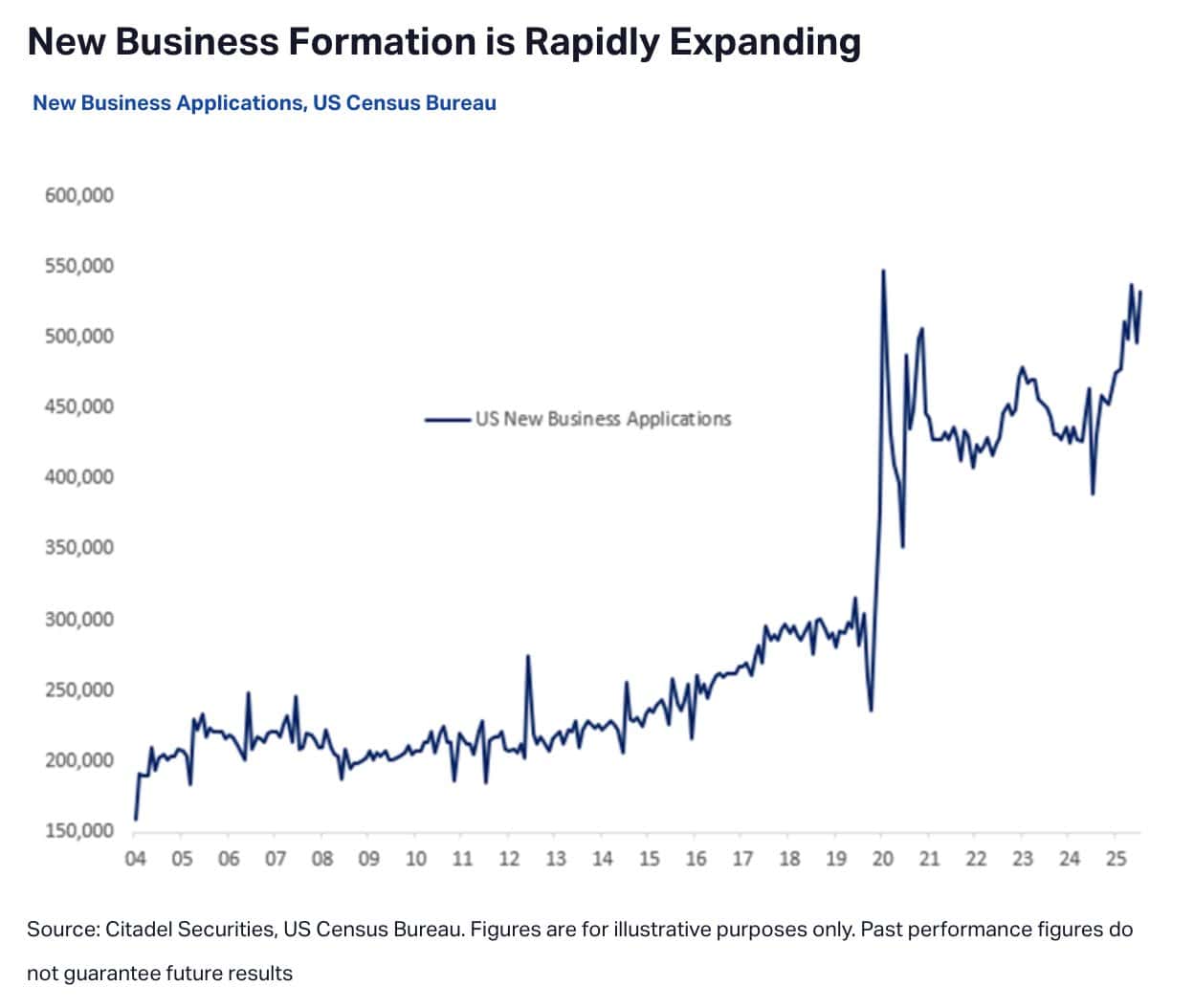
US Census Bureau data confirms it: new business formations are growing at a pace we haven’t seen in years. Each one needs a website, an app, some automation. This drives demand for developers, but also changes what the work actually is.

Productivity growing faster than employment

Shapiro asks the question: what happens when unmet software demand finally gets saturated? One developer with AI does today what three did without it. The “ladder” into the profession is gradually disappearing.

Shapiro draws a comparison to US manufacturing, where industrial output tripled over 50 years, but jobs in the sector were cut in half. For years nobody noticed because productivity growth compensated for employment decline. Until one day, there was nothing left to compensate.

Jack Dorsey and Block: the first big "AI cut"

While I was writing this article, Jack Dorsey, the founder of Twitter and CEO of Block, announced he’s cutting nearly half the company. From over 10,000 people to just under 6,000. Over 4,000 people gone. In a single memo.

Here’s the thing: Block isn’t in trouble. Gross profit is growing, the company is serving more customers, profitability is improving. Dorsey writes plainly: “the intelligence tools we’re creating and using, paired with smaller and flatter teams, are enabling a new way of working which fundamentally changes what it means to build and run a company. And that’s accelerating rapidly.”

He had two options: cut gradually over months or years, or be honest and act now. He chose the latter, arguing that repeated rounds of cuts destroy morale, focus, and trust.

Balaji Srinivasan, author of “The Network State”, commented: “This is the first AI cut. And it will send shockwaves.” His message to the industry is blunt: get good with AI tools and raise your game. Or you might not survive the selection, as an employee or as a company. Capitalism is natural selection. The market is unforgiving, because you are the market.

How do you reconcile these data points? Citadel says job postings are up, the panic is premature. Jack Dorsey cuts 40% of his company because AI changes how work gets done. Both things are true at the same time. Overall demand for software is growing, but individual companies need fewer people to build it. This is exactly what Shapiro was talking about.

What does this mean?

Both are right. They’re looking at the same market from different time horizons.

Over the next 2-5 years, developer demand is growing. AI complements the work, it doesn’t replace it. New businesses are forming faster than ever and each one needs software. Flight’s data is clear: the panic is premature. I’ll admit, as an automation advocate, I didn’t expect to be writing this.

Further out, in the 5-15 year range, Shapiro’s warning is on point. When AI productivity outpaces the creation of new markets, structural change will follow. What happened to factories can happen to code.

If you’re a developer, learn to work with AI instead of against it. The job market isn’t ending, but it’s changing faster than anyone predicted. Myself included.

Read more about ATS and Element here.

DISCOVER ELEMENT!

Fast, agile and user-friendly ATS created by recruiters for recruiters
Picture of Maciej Michalewski

Maciej Michalewski

CEO @ Element. Recruitment Automation Software

Facebook
Twitter
LinkedIn

Recent posts: