
Let a man recruit me
“A candidate prefers to be recruited by a man rather than artificial intelligence.” I recently read in a Facebook comment.
Are you sure?
The last episode of the World Science Festival, with a meaningful title Outsourcing Humanity, discussed progress in the development of artificial intelligence. The episode presents the successes and failures that arise during the development of this technology. Among the successes were promising results in the detection of breast cancer. Among the failures, the spectacular fiasco of artificial intelligence tested in Amazon recruitment processes. The reasons for Amazon’s failure resulted from the fact that incorrectly prepared data was used to learn AI algorithms. These data concerned historical recruitment processes in which male candidates were the preferred candidates. The algorithm, learning from such data, also preferred men, which quickly came to light and a spectacular failure became a fact.
However, my special attention was drawn to the case of a completely different failure, not directly related to artificial intelligence.
A case, whose analysis can shake the faith in human judgment, comes from an area that should be the backbone of the most accurate and just decisions – the justice system.
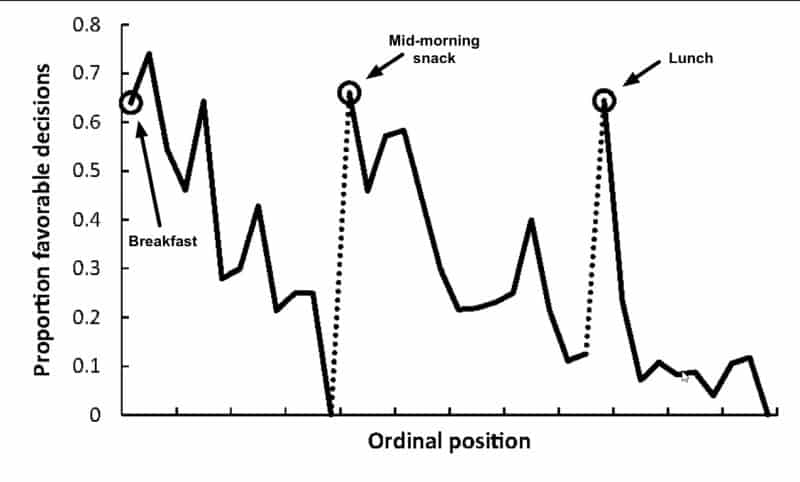
In 2011, a study by the American Academy of Sciences was published, which revealed quite shocking results of the analysis of court decisions in parole cases. More than 1,000 judgments issued within ten months by eight experienced judges were examined. The research shows that the highest probability (65%) of obtaining a positive court decision was immediately after breakfast (its not a joke). This probability was then constantly decreasing, and before the next meal, it was almost zero. The result of the research is presented in the chart below:
As you can see, before the break for “second breakfast” and lunch, there is little chance for a positive court decision. Right after the meal, the chance reaches its maximum. I wouldn’t have believed this research if I hadn’t seen it in a credible scientific program, and then I wouldn’t have reached the sources at the American Academy of Sciences (https://www.pnas.org/content/108/17/6889.full). The conclusion of the study was the following:
Indeed, the caricature that justice is what the judge ate for breakfast might be an appropriate caricature for human decisionmaking in general.
Analyzing the above, I remembered a comment about a candidate who prefers to be hired by a man rather than artificial intelligence. However, since court decisions may be so susceptible to factors unrelated to the subject matter of the case and to the exercise of the profession of judge in general, can we expect guarantees of objective, fair decisions from a modest recruiter?
This question is a good introduction to further reflection on the use of artificial intelligence in recruitment. This, as well as the development of Artificial Intelligence algorithms in the Element ATS, will be discussed in subsequent posts on our blog.
Related posts:
Please also:
Maciej Michalewski
CEO @ Element. Recruitment Automation Software
Recent posts:

Open AI trainings I run in person
Most of my AI trainings are closed, but a few are open with my own authorial program. Here is what I run with EY and Altkom Akademia, and how to sign up.

Element is developing faster than ever before
I am not a programmer, yet today I generate thousands of lines of Element’s code with AI. How vibe coding changed the pace of our recruitment system.

Element now has an API: recruitment that plugs into your own systems
Element now has a public API (v1-beta). I explain what integrations give recruitment-system clients, the mistakes I made and what they taught me.

Recruiting from your phone: Element is now mobile, built by AI
Element’s mobile views are in production. Recruiters and hiring managers now run the process from a phone, and AI wrote 15,000 lines of code in five weeks.

You get an email from AI instead of a human, problem?
Getting an email from AI instead of a human is fine, as long as the data stays high quality. Most routine work is algorithmic, and the outcome matters more than the author of the message.

The AI job apocalypse is a fantasy, says a16z. But Poland?
David George of a16z says the AI job apocalypse is a fantasy. I test his thesis against Polish data and a fresh vibe coded experiment of my own.