
Coronavirus - market and recruitment situation, March 2020
Summary of current information on the impact of Coronavirus on the business and recruitment situation. Information collected from several sources, including our business partners and Element‘s Job Monit module, which monitors over 50 Polish job boards.
Going up by coronavirus
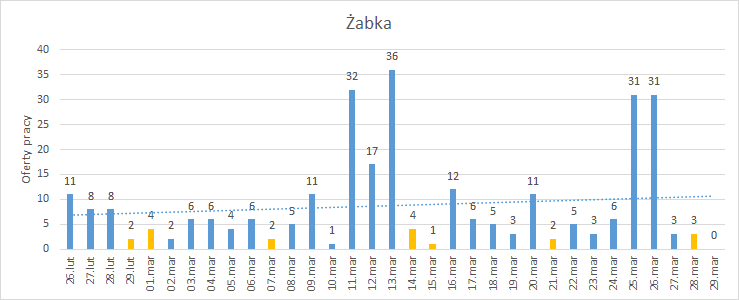
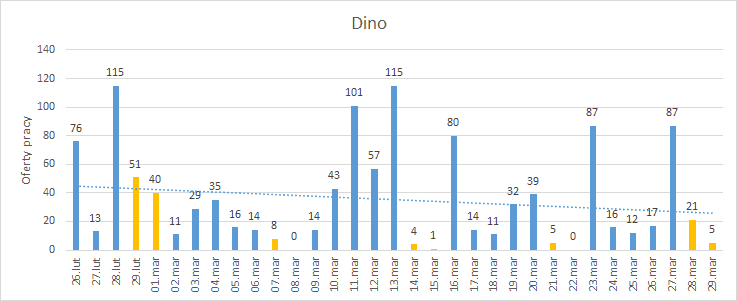
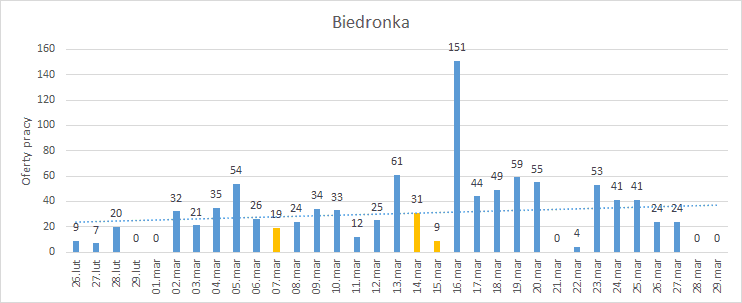
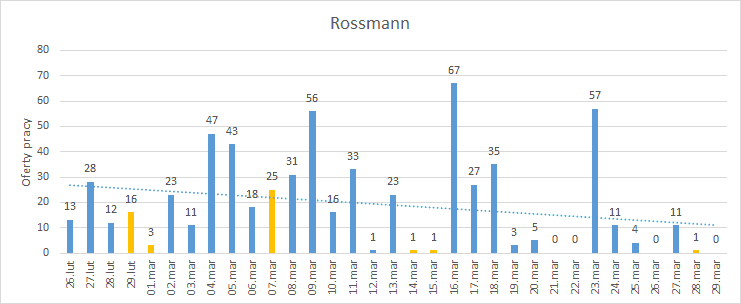
- The food industry needs employees. There were a significant number of new vacancies, especially around mid-March. According to reports, the increase in the value of the food shopping basket was 57% (Nielsen) in this period. The graph below is presenting job ads published by a few leading food chains.
- The demand for employees in the distribution industry (e.g. warehouse workers) is growing due to the growth in the e-commerce industry.
- There is also a growing demand for programmers in e-commerce projects, telemedicine, tools for remote work.
- New needs for employees in the toy industry have emerged.
Going down by coronavirus
- Transport, hotel, tourism, catering, automotive industry (production stopped due to lack of raw materials, health concerns of employees, reduced demand for services and goods).
- Redundancies in the clothing industry. There is a risk of bankruptcy even for companies operating recognized brands.
- The automotive industry has stopped. Both car manufacturers, component suppliers, warehouses.
- The IT industry, although it was supposed to be doing well, is also beginning to feel the effects of the current situation. Programmers are starting to ask more often for jobs and projects; some IT companies are reducing employment.
- Recruiters start losing their jobs.
- Earnings reductions and redundancies in banks.
- Banks and leasing companies suspend payments for 3 to 6 months, especially for the catering and tourism industry. In one of the leasing cases my friend was called by a leasing company and informed about the reduction of the installment from PLN 2000 to PLN 500 for 6 months (car leasing), even though my friend didn’t ask for it.
Job ads report for Żabka, Dino, Biedronka and Rossmann
Further reports from the ATS Element system
This week (probably Thursday) we will present a larger report on recruitment announcements, presenting key industries and the most popular positions.
Finally, a useful link for everyone who wants to have access to constantly updated pandemic data, statistics from around the world in one place: https://www.worldometers.info/coronavirus/.
Related posts:
- Who benefits from the coronavirus?
- Coronavirus – job ads report from weeks 11 and 12
- How we gather data for recruitment reports
Please also:
Maciej Michalewski
CEO @ Element. Recruitment Automation Software.
Recent posts:

The autonomous company: how Replit does it with AI agents, and how to do it yourself
Replit built an autonomous company: a fleet of AI agents where people choose the goals and automations handle the steps. I break down the pattern and how to run it yourself.

How to reject a candidate without ghosting: Glen Cathey’s playbook
Ghosting applicants isn’t a volume problem, it’s a priority problem. I walk through Glen Cathey’s rejection playbook: 6 rules, 7 templates and ATS setup.

Poland’s job market turns positive: 259,000 postings, all ten cities growing
Poland posted 259,000 job ads in June 2026, the first positive year-over-year reading in more than a year. The Grant Thornton and Element report reads it as a cautious but real turnaround.

What’s new in Element: a month of concrete improvements for recruiters
A roundup of what’s new in Element this month: saved filters, GDPR and consent tracking, candidate SMS, a new public API, and stronger data security.

Career in the age of AI agents: what really counts, per Phil Chen
Phil Chen (Helm AI, Scale, OpenAI, DeepMind) argues that in the age of AI agents, finding problems, the last mile and reputation matter more than solving tasks. A summary plus my HR take.

AI isn’t taking jobs. Companies that invest in it hire more
A Ramp study of 21,599 US firms finds that companies investing seriously in AI grow headcount 10.2% in two years, including entry-level roles. The data pushes back on AI job-loss panic.