

Let a man recruit me
“A candidate prefers to be recruited by a man rather than artificial intelligence.” I recently read in a Facebook comment.
Are you sure?
The last episode of the World Science Festival, with a meaningful title Outsourcing Humanity, discussed progress in the development of artificial intelligence. The episode presents the successes and failures that arise during the development of this technology. Among the successes were promising results in the detection of breast cancer. Among the failures, the spectacular fiasco of artificial intelligence tested in Amazon recruitment processes. The reasons for Amazon’s failure resulted from the fact that incorrectly prepared data was used to learn AI algorithms. These data concerned historical recruitment processes in which male candidates were the preferred candidates. The algorithm, learning from such data, also preferred men, which quickly came to light and a spectacular failure became a fact.
However, my special attention was drawn to the case of a completely different failure, not directly related to artificial intelligence.
A case, whose analysis can shake the faith in human judgment, comes from an area that should be the backbone of the most accurate and just decisions – the justice system.
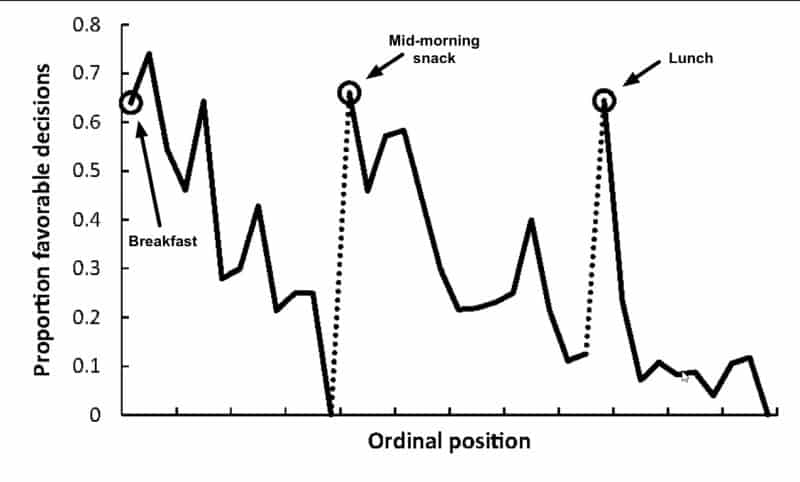
In 2011, a study by the American Academy of Sciences was published, which revealed quite shocking results of the analysis of court decisions in parole cases. More than 1,000 judgments issued within ten months by eight experienced judges were examined. The research shows that the highest probability (65%) of obtaining a positive court decision was immediately after breakfast (its not a joke). This probability was then constantly decreasing, and before the next meal, it was almost zero. The result of the research is presented in the chart below:
As you can see, before the break for “second breakfast” and lunch, there is little chance for a positive court decision. Right after the meal, the chance reaches its maximum. I wouldn’t have believed this research if I hadn’t seen it in a credible scientific program, and then I wouldn’t have reached the sources at the American Academy of Sciences (https://www.pnas.org/content/108/17/6889.full). The conclusion of the study was the following:
Indeed, the caricature that justice is what the judge ate for breakfast might be an appropriate caricature for human decisionmaking in general.
Analyzing the above, I remembered a comment about a candidate who prefers to be hired by a man rather than artificial intelligence. However, since court decisions may be so susceptible to factors unrelated to the subject matter of the case and to the exercise of the profession of judge in general, can we expect guarantees of objective, fair decisions from a modest recruiter?
This question is a good introduction to further reflection on the use of artificial intelligence in recruitment. This, as well as the development of Artificial Intelligence algorithms in the Element ATS, will be discussed in subsequent posts on our blog.
Related posts:
Please also:
Maciej Michalewski
CEO @ Element. Recruitment Automation Software
Recent posts:

The autonomous company: how Replit does it with AI agents, and how to do it yourself
Replit built an autonomous company: a fleet of AI agents where people choose the goals and automations handle the steps. I break down the pattern and how to run it yourself.

How to reject a candidate without ghosting: Glen Cathey’s playbook
Ghosting applicants isn’t a volume problem, it’s a priority problem. I walk through Glen Cathey’s rejection playbook: 6 rules, 7 templates and ATS setup.

Poland’s job market turns positive: 259,000 postings, all ten cities growing
Poland posted 259,000 job ads in June 2026, the first positive year-over-year reading in more than a year. The Grant Thornton and Element report reads it as a cautious but real turnaround.

What’s new in Element: a month of concrete improvements for recruiters
A roundup of what’s new in Element this month: saved filters, GDPR and consent tracking, candidate SMS, a new public API, and stronger data security.

Career in the age of AI agents: what really counts, per Phil Chen
Phil Chen (Helm AI, Scale, OpenAI, DeepMind) argues that in the age of AI agents, finding problems, the last mile and reputation matter more than solving tasks. A summary plus my HR take.

AI isn’t taking jobs. Companies that invest in it hire more
A Ramp study of 21,599 US firms finds that companies investing seriously in AI grow headcount 10.2% in two years, including entry-level roles. The data pushes back on AI job-loss panic.